
You launch your webinar ads. Leads start rolling in. You feel that little dopamine hit — it’s working!
Then you check the dashboard. $40 per registration. $60 per registration. And barely half of them show up.
So you tweak the targeting. Swap the creative. Jump from Facebook to YouTube hoping the grass is greener. Six weeks later, you’ve learned something important: the grass is the same shade of brown on every platform.
Here’s what nobody tells you. Webinar ads are not regular lead gen ads.
A lead gen ad sells a thing. A webinar ad sells an experience. That distinction changes your messaging, your audience strategy, your creative, and how you scale. Get it wrong and you’re filling a bathtub with the drain wide open.
Below is the exact 4-part system we use at Radical Marketing to get webinar registrations consistently under $10. We call it the Webinar Ad Amplification System.
The Webinar Ad Amplification System: The 4 Components of Paid Ads That Actually Scale
Every profitable webinar campaign I’ve seen — on Facebook, on YouTube, across every niche — follows the same four-part structure:
- Platform Architecture — picking the right platform and staying there
- Hook Science — writing ads that sell the experience of attending
- Audience Architecture — layering cold, warm, and hot audiences properly
- Scaling Logic — knowing when and how to turn up the volume
Miss any one of these and the whole thing falls apart. Let’s go through each.
Platform Architecture – Why Splitting Your Budget Across Platforms Is Slowing You Down
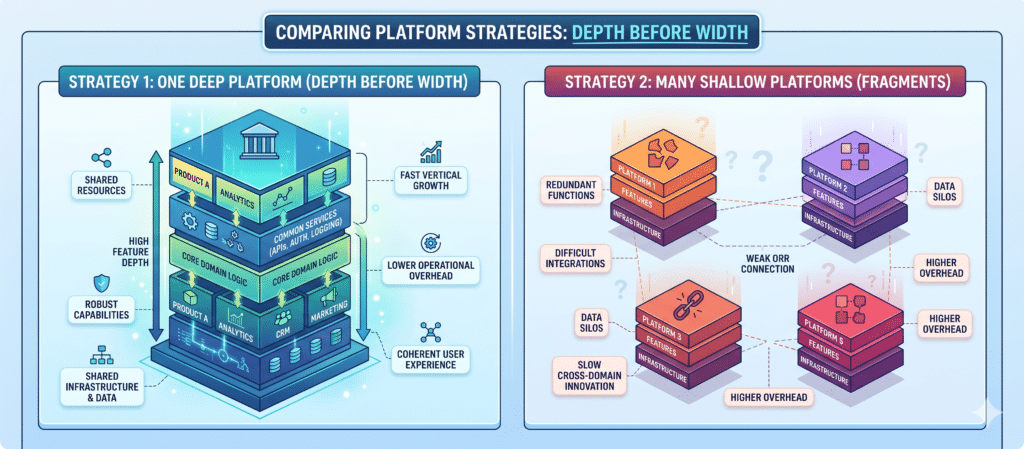
The most common mistake I see? Coaches splitting their budget across Facebook, YouTube, LinkedIn, and TikTok all at once — because they don’t want to “miss” anyone.
The problem with being everywhere at once
What actually happens is they spread so thin they don’t learn anything meaningful about any platform. It’s like spending two weeks learning Spanish, then switching to Mandarin, then French, then Arabic. Six months later, you can say hello in 12 languages but you can’t order food in any of them.
The principle: Depth Before Width
Pick one platform and master it. Then — and only then — stack the next one on top of a proven system. That way you’re sniping with a scope, not spraying with a shotgun.
How to choose your starting platform
Ask two questions: Where does your ideal client already spend time watching content? And where are your biggest competitors advertising consistently? If they’re spending money on a platform month after month, the audience is proven. That’s your starting point.
Switching platforms won’t fix a broken campaign — it just gives you the same broken campaign in a new zip code.
The takeaway?
Own one platform first. The fastest path to scale isn’t more platforms — it’s a mastered system you can then multiply.
Hook Science — Sell the Experience of Attending, Not the Webinar Itself
Your webinar ad has exactly one job.
It’s not to explain what the webinar covers. It’s not to list the seven things people will learn. It’s not even to communicate your credentials.
It’s this: sell the experience of attending.
The difference:
selling a webinar vs. selling a result
Most webinar ads sound like this:
“Join my free training where I’ll share my top strategies for growing your coaching business.”
Generic. Forgettable. Scroll-past material.
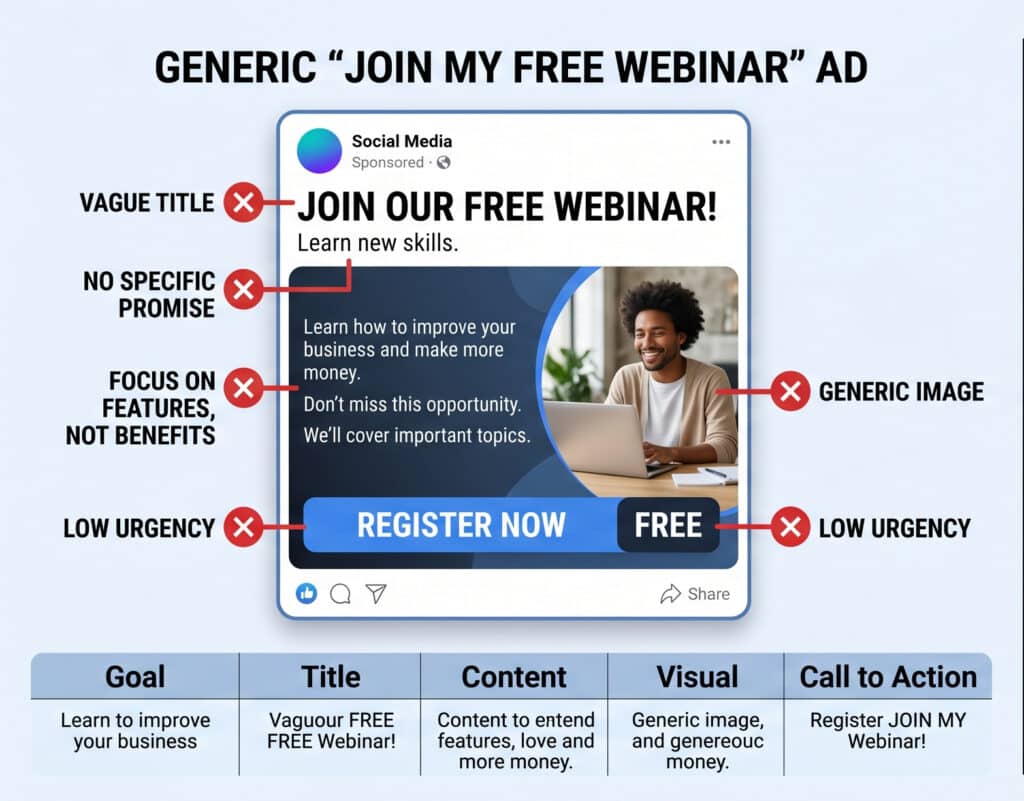
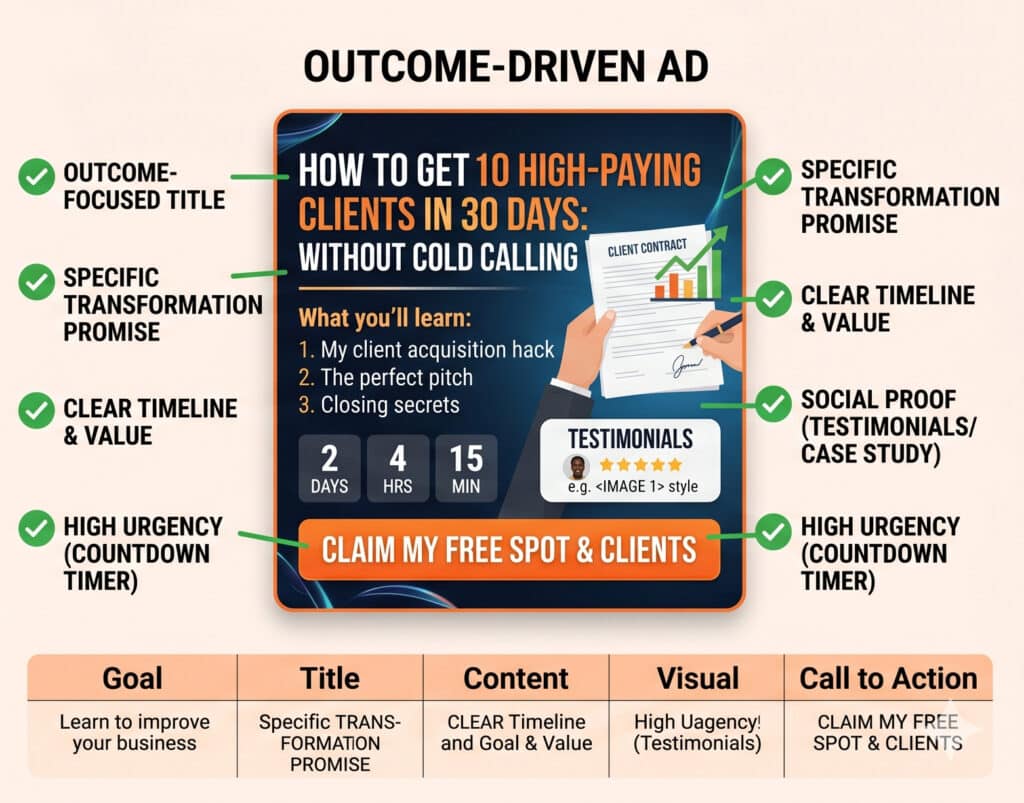
Here’s what selling the experience sounds like:
“In 60 minutes, you’ll understand exactly why your last webinar didn’t convert — and the three-step fix that’s taken clients from burning budget to 8X returns.”
One makes someone think “yeah, sounds interesting.” The other makes someone think “I need to be in that room.”
How to find hooks that actually work
Don’t sit in a cafe brainstorming in a vacuum. Write 10-20 different hooks, put them on image ads, and let the data tell you which ones resonate.
When a hook starts to get stale (it will), don’t swap the image for ten different shades of grey and call it a “creative refresh.” That’s like putting a new bumper sticker on a car that won’t start. Rotate your opening lines and headlines instead — that’s where the real juice is.
On YouTube it’s even more brutal. If you don’t hook someone in the first five seconds, they skip. You paid for nothing, and they left annoyed.
Validate the big idea before you invest in creatives
This is where our Blitzvertising system comes in. Instead of running one ad and praying, we test multiple big ideas around the same topic simultaneously — then let the data tell us which concept wins before we invest in building creatives around it. Most people test creatives first and never find out if the core marketing idea is even strong. That’s backwards. Validate the idea first. Then build.
The takeaway?
Stop selling your webinar. Sell what it feels like to walk away with the answer. One validated hook can outperform a hundred random creative variations.
Audience Architecture — The 3 Audiences Most Coaches Never Build
If you’re only running webinar ads to cold traffic, you’re essentially proposing marriage to strangers on the street. No first date. No coffee. Just “REGISTER FOR MY WEBINAR, PLEASE.”
And then you wonder why nobody shows up.
The Three Temperature Model
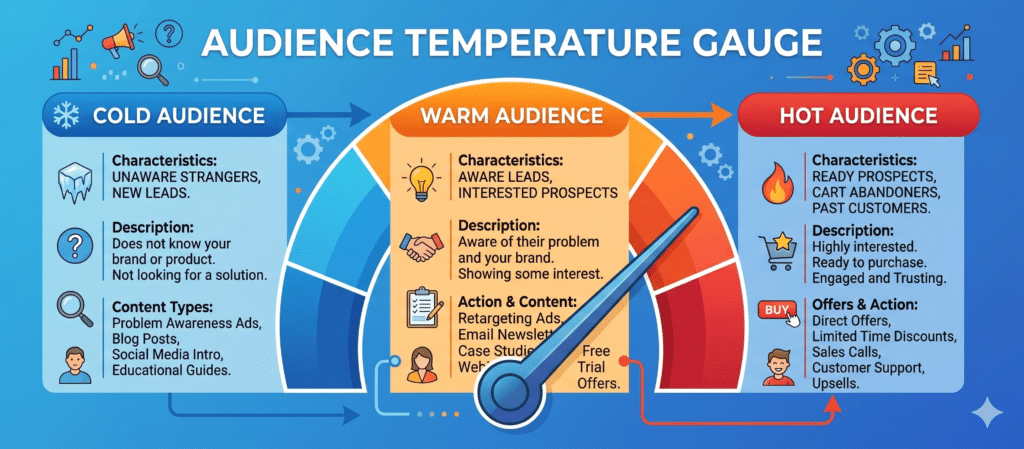
Cold audiences: for reach
Warm audiences: for trust
Hot audiences: for conversion
Strangers. People who’ve never heard of you. They need a pattern interrupt and a strong pain-based hook just to get them to stop scrolling. But relying only on cold traffic is the most expensive way to fill a webinar.
People who’ve engaged with you in some way — watched your videos, visited your pages, clicked your landing page but didn’t register. They know who you are. They just haven’t committed yet. This is where you show ads to people who’ve already “met you,” and it consistently delivers better returns than cold traffic because the trust is already partly built.
The people most coaches completely ignore — and that’s a mistake. These are people who registered but didn’t show. People who attended but didn’t buy. They don’t need more information. They need permission to trust you. Testimonial videos work incredibly well here.
The underused strategy:
the Video View Warm-Up
This is one of the most underused strategies in all of webinar advertising.
Before sending cold traffic straight to your registration page, run a short video campaign first. No opt-in. No call to action. Just get people familiar with your face and your philosophy. Then show registration ads to everyone who watched 50% or more of the video.
These people convert dramatically better — both in signing up and in actually showing up — because the trust is already there. This approach is one of the key reasons we were able to hit an 84% show-up rate in one campaign.
Sometimes, saying hello first works better than leading with a proposal.
The takeaway?
Cold for reach. Warm for trust. Hot for conversion. If you’re only running cold ads, you’re leaving your most valuable audiences on the table.
Scaling Logic — The 3 Green Lights to Check Before You Turn Up the Budget
Here’s where most coaches blow themselves up.
A few registrations come in. The numbers look okay. So the thinking goes: “If I triple my budget, I’ll get triple the results.”
That’s not what happens. What happens is they scale a leak, not a money-printing machine.
The Three Green Lights
Before you scale anything, three things need to be true.
Green Light #1
Your ad cost per registration is below your target
Green Light #2
At least 30% of registrants actually show up live
Green Light #3
You're making more money back than you're spending
Method 1 — Budget scaling
Increase your spend by 20-30% every three to five days. The algorithm needs time to recalibrate. Push it too fast and performance collapses. I’ve seen ad costs triple overnight because someone got excited and doubled the budget on a Friday afternoon. Slow is fast when it comes to scaling.
Method 2 — Creative scaling
Introduce new creatives — new hooks, new angles, new formats — into the same campaign. This often outperforms budget increases because you’re expanding reach without disrupting what’s working. It’s also how you stay ahead of ad fatigue. Your winning ad from last month is dying right now — you just can’t see it yet.
Method 3 — Duplication
Clone your winning ad set into new campaigns with new audiences. Same proven creative, fresh distribution. You’re not touching what’s working — you’re cloning it into new territory.
The takeaway?
Scaling a broken system just makes it break faster. Three green lights first. Then scale with creatives and duplication — not just your wallet.
The Proof: What This System Looks Like When It's Running Properly
The starting point: bleeding money on Facebook
A client came to us spending $5,000 a month on Facebook ads for his webinar.
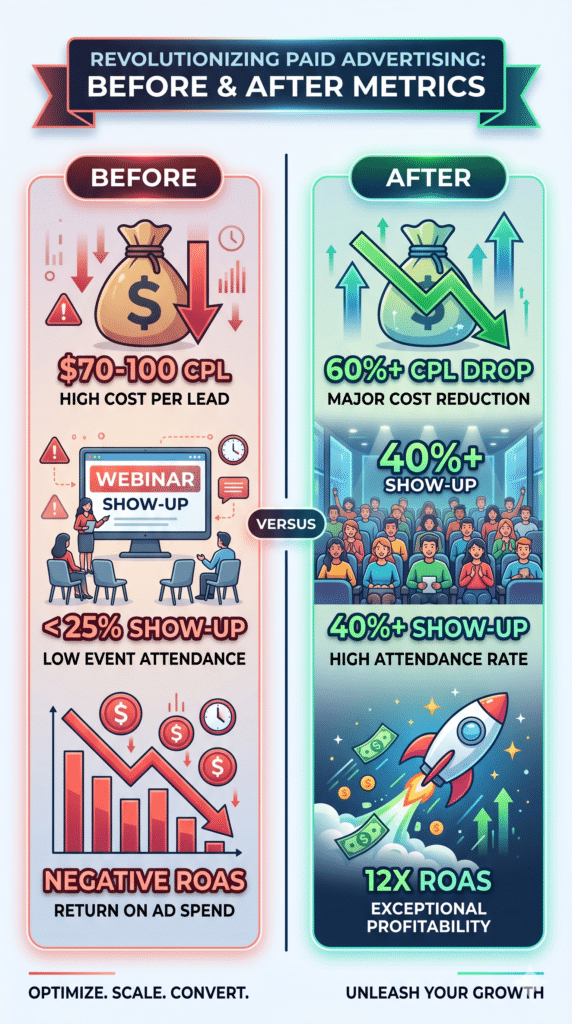
It was costing him $70-$100 every time someone signed up. Less than 25% of those registrants were actually showing up live. And for every dollar he put into ads, he was getting less than a dollar back — he was losing money on every campaign.
The three problems we found
When we dug in, the issues were immediately obvious:
- His ads sounded exactly like his competitors — same big ideas, same tired hooks, same generic angles.
- Zero warm-audience ads. Anyone who visited his pages without registering was being lost forever.
- The people clicking had no idea who he was. In their minds, he was no different than the dozens of other gurus flooding their feed. They registered out of mild curiosity, not real intent.
What we changed
We ran the Webinar Ad Amplification System on him.
Video warm-up campaigns on a small budget. Then registration ads to the people who’d watched those videos. Blitzvertising to test fresh big ideas on his core topic.
The result in 45 days
Cost to sign someone up dropped by over 60%. Show-up rate climbed above 40%. And for every dollar he put into ads, he was now getting $12 back.
Same platform. Same offer. Same person. Completely different system.
(And his business stopped sponsoring Mark Zuckerberg’s expensive jiu-jitsu lessons — which I think he appreciated.)
Want more proof? We’ve got case studies ranging from 10X returns on revived webinars to landing page tweaks that tripled leads.
Where to Start Based on Where You Are Right Now
If you're just getting started with paid ads
Focus on Components 1 and 2 first. Get your platform right. Get your hook right. That alone puts you ahead of 80% of people running webinar ads today.
If you already have campaigns running but the numbers aren't there
Go straight to Component 2. The message is almost always where you get the most leverage. Fix that before you touch anything else.
If you want a team to build the whole machine for you
We should talk.
We’ve been filling webinar rooms since 2014. We’ve generated over 1.5 million leads. And we work on a performance basis — we only win when you win.
Prefer to go deeper on your own first? Grab a free copy of Lead Surge — it covers 8 proven funnels for coaches and experts.
Watch the full video on
How to Advertise a Webinar: The 4-Part System for Scaling Paid Traffic
OR Listen Here