Table of Contents
Your Funnel Is Working. But Is It Maximised?
Your webinar is running. Leads are coming in. You’re making sales.
So why does it feel like you’re leaving money all over the floor?
In over a decade of running webinar funnels for coaches and course creators, I’ve found that the biggest revenue gaps almost never live in the ads. They live in the strategy around the ads, the stuff nobody’s talking about.
Here are 7 real strategies, from 7 real clients, on how to make money from an existing webinar funnel that unlocked significantly more revenue from funnels that were already up and running.
Strategy 1:
The Money Really Is in the List (No, Seriously This Time)
“The front-end sale is not the business. The email list is the business.”
You’ve heard “the money is in the list” so many times it’s basically wallpaper. My client Vince actually built his entire business model around it and what he did with it is unlike anything I’ve seen.
When we started working together, his webinar funnel was generating a 2–3x return on ad spend from the front end. Decent. Profitable. Most people would’ve stopped there.
Vince wasn’t interested in “decent.”
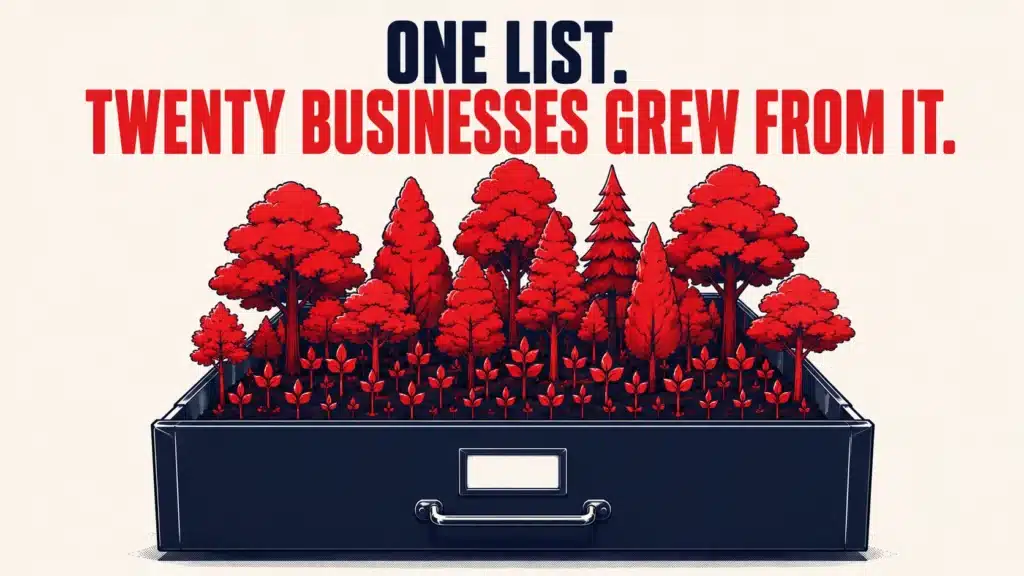
He used his webinar traffic to build a list of over 100,000 people, then launched more than 20 other course creators to that same audience — and took an equity stake in each business he helped launch.
One webinar funnel. One list. 20 different revenue streams, where he doesn’t just get paid for the launch. He owns a piece of their business.
It’s like building the cinema, selling the popcorn, and getting a cut of every movie that plays there.
The lesson? Ask yourself what you’re actually doing with your list. If the answer is “sending a weekly email and occasionally promoting my program”… the opportunity is much bigger than you think.
Strategy 2: Stop Running A Webinar and Start Running a Conversion Engine
“Most people run one webinar, get disappointed, and blame the ads.”
Most coaches treat webinars like a coin flip. It either converts or it doesn’t, and then you try again next month.
My client Jerry had a completely different philosophy. He already ran a 7-figure coaching business in Asia when he came to us and over 5 years, his business grew nearly 3x. The reason: he treats webinars as a precision conversion engine, not a one-shot event.
His model: multiple lead magnets generating thousands of leads every month, segmented by interest, with dedicated webinars for each segment. Low-commitment trial classes act as an easy entry point. Non-buyers get hit with bundles and flash sales. Every touchpoint is designed to pull people toward the same end goal.
Instead of one shot at conversion, he has multiple opportunities at multiple commitment levels…all funnelling in the same direction.
The lesson? A webinar is one conversion event in a sequence, not the whole strategy. If it’s the only shot you give your leads, you’re leaving a lot on the table every single month.
Strategy 3: Most Webinar Funnels Don't Have an Ad Problem. They Have a Messaging Problem
“He was using the same angles as every other trading course on Facebook. Same hook. Same big ideas. Same language. He was invisible.”
When results are flat, the first instinct is always to blame the ads. But I’ve seen it too many times, the problem isn’t the ad. It’s what the ad is saying.
Two examples:
- Roy teaches metaphysics and manifestation. Good product, solid audience but stuck at a six-figure ceiling because his messaging sounded identical to every other manifestation coach online. We repositioned him around one specific idea: create your own luck using ancient wisdom. He went from six figures to seven figures.
- Ethan runs a trading education program and was breaking even ($1 in, $1 out). His previous agency had copy-pasted the same hooks every other trading guru was running. He was invisible. We repositioned him around AI-powered trading strategies, tapping into a conversation his audience was already having before competitors caught on. Result: 12x return on ad spend in the very first webinar.
Same offer. Better positioning. Completely different outcome.
This is exactly what our Blitzvertising system is designed to find, not just a better creative, but a genuinely different big idea that makes your audience stop and think “huh, that’s different.”
The lesson? If your ads aren’t working, check the messaging before you check the targeting. In a noisy market, “same” is invisible.
(This is the same principle behind message testing before you ever touch production, one of the four levers we cover in our full guide to webinar lead generation.)
One High-Ticket Offer Is Quietly Limiting Your Revenue
“Some people are a $97 decision today. Some are ready to invest $500,000 nine months from now.”
If your webinar only leads to one product, you’re capturing only the people whose readiness happens to match that one price point. Everyone else leaves.
My client Michael came to us with something I can’t take credit for: a properly built value ladder from 10+ years in the info marketing space. We helped him grow 2.5x in the first three years. The offer structure is what made it possible.
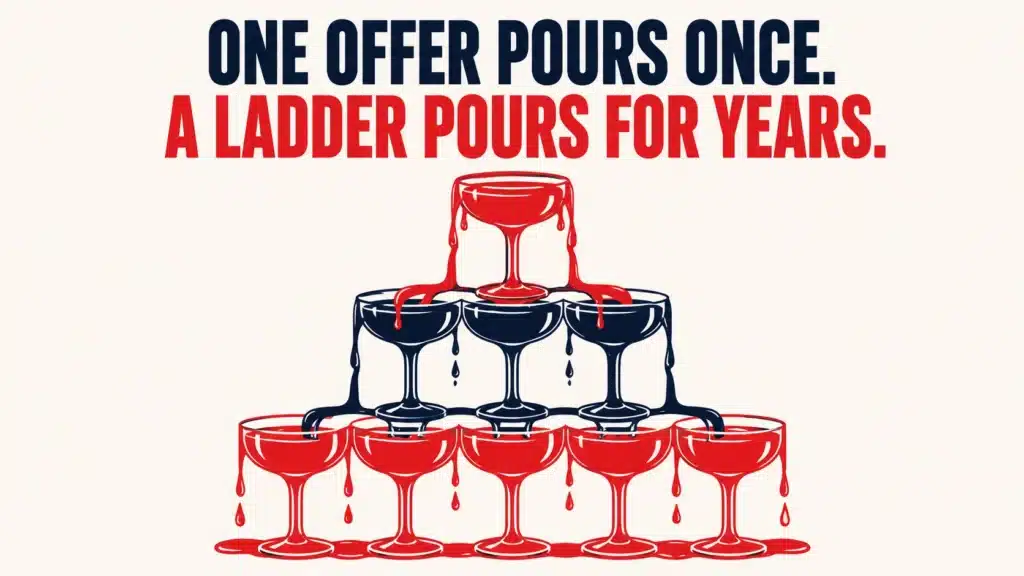
Here’s how it works: the webinar sells a low-ticket two-day program, an easy entry point. That program sells a mid-range one-year membership. From there, higher-end training is available for those who want to go deeper. And at the top? Investment opportunities in real estate and other programs for his most committed long-term clients.
That’s serving your audience at every level of readiness, from someone spending $97 today to someone putting six figures into a deal nine months from now.
The lesson? A value ladder captures every buyer, not just the ones ready to say yes at one price point right now. If your webinar only leads to one offer, you might be missing the majority of your revenue.
“Zero extra ad spend. One launch. £85,000.”
This is my personal favourite on this list. The idea is almost embarrassingly simple.
My client Mark runs a monthly webinar. After each event, there’s a chunk of people who either missed it or attended but didn’t buy…traffic already paid for, trust already built, and then nothing.
We suggested running a simple on-call replay for those people. Mark thought it was too basic to matter.
The on-call started generating more sales than the original live event.
Then we launched a new offer to his existing email list. No new ad spend. One launch. £85,000.
This works because the trust is already there. The relationship is already built. You already paid to acquire that person. Not going back to them with new offers is like paying for a full restaurant and only serving the starter.
For more examples of backend monetisation working in practice, our case studies page has several worth reading through.
The lesson? Before spending another cent on new traffic, look at what you’re doing with the audience you already have. An on-call webinar or a well-timed offer launch could be the highest-ROI move you make this month.
“Check whether you’re teaching people out of buying from you.”
This is the most uncomfortable lesson on the list. Because the problem isn’t the ads, the funnel, or the offer.
It’s what’s happening inside the webinar itself.
When we started working with Owen, we brought his lead costs down to roughly a quarter of what competitors in his industry were paying. Attendance was at 60%. Around 90% of attendees stayed until the very end. By every external metric, the funnel was working.
Six weeks in: two sales on his high-ticket program.
We watched the webinar and the issue was obvious: too much how-to. Too much teaching. Not enough paradigm shifting.
Here’s the distinction: a how-to webinar gives people knowledge. Knowledge is great. Knowledge does not close sales. What closes sales is changing how someone sees their problem and making them believe your solution is the thing that solves it.
Owen’s webinar was so packed with actionable content that by the end, attendees felt educated, grateful… and completely sorted. No reason to buy.
We restructured the presentation…less tactics, more belief shifting. The following week: seven applicants, two high-ticket sales. More in one week than the previous six combined.
The lesson? Watch your own webinar with fresh eyes. Ask honestly: by the end, does someone feel like they need your program or do they feel like they can probably figure it out on their own now?

“When everything gets filtered through one person’s gut feel, not data, you end up with a very narrow, uniform set of ads. And the algorithm reads that as the same message.”
This last one isn’t a clever strategy. It’s a warning.
We had a client doing six-figure launches for eight solid months. Strong results, everything clicking. Then results started to slide. The last event barely broke even.
What changed? The client started restricting our creatives and messaging. Reviewing and approving every word before anything went live. We’d script videos; they wouldn’t record them. Everything ran through personal preference instead of data.
Here’s the problem: Meta’s Andromeda update (their new AI system for ad delivery) actively rewards creative diversity…different angles, different messages, all running simultaneously.
When every ad is filtered through one person’s taste, you end up with a narrow, uniform set of creatives. The algorithm reads it as one message, gets bored, and tanks your performance.
This is now something we actively assess when taking on new clients: can they give us creative freedom to test and iterate based on data? Not because your opinion doesn’t matter but because the data has to drive the decisions, not gut feel.
The lesson? Creative diversity isn’t optional anymore. The moment you try to control every word going out, you’re not protecting your brand. You’re suffocating it.
The Bottom Line
None of these strategies required starting from scratch. No tearing down the funnel, no scrapping the offer, no switching platforms.
Just looking at what was already there (the list, the backend, the presentation, the messaging, the offer structure) and making targeted changes that unlocked revenue already within reach.
Sometimes it’s one repositioned message. Sometimes it’s a single on-call webinar. Sometimes it’s a new offer to a list you already paid to build. And suddenly the numbers look completely different.
FAQs: 7 Smart Ways to Make More Money From Existing Webinar Funnel
The fastest way to make money from an existing webinar funnel usually comes from what happens around the webinar, not the ads themselves. That means monetising your email list beyond weekly promos, running on-call replays for non-attendees, launching new offers to buyers already on your list, and adding a value ladder so every readiness level has an offer.
High attendance with low sales usually points to a messaging problem inside the webinar, not the funnel. If the presentation is packed with how-to tactics, attendees leave feeling educated and self-sufficient instead of convinced they need your program. Shifting from teaching to belief-shifting content typically restores conversions.
A value ladder is a sequence of offers at increasing price points, from a low-ticket entry program up to high-end coaching or investment opportunities. Without one, a webinar funnel only converts leads whose budget matches its single price point, and it misses buyers who are ready to spend either far less or far more.
Yes. Attendees who didn't buy already trust you and cost money to acquire, so re-engaging them costs nothing extra. Sending an on-call replay or launching a new offer to your existing list can generate meaningful revenue without additional ad spend, since the relationship and traffic are already paid for.
A sudden drop often follows reduced creative diversity, such as one person approving every ad before it runs. Meta's ad-delivery system rewards varied creative angles tested simultaneously; a narrow, uniform set of ads gets read as one message and the algorithm's performance drops accordingly.
Radical Marketing Helps to Find Money from Your Existing Webinar Funnel
If you’re running a webinar funnel and wondering where you’re leaving money on the table, let’s find out together.
At Radical Marketing, we’ve spent over a decade and generated more than 1.5 million leads across dozens of coaching niches. We know where the gaps usually are.
And if you want to start with some reading first, grab a free copy of my book Lead Surge: 8 Radically Effective Marketing Funnels for Coaches and Experts. Download it here for free.