
Table of Contents
Building a Webinar System That Converts
Imagine spending weeks building a webinar. You write the slides. You rehearse the pitch. You pour money into ads.
Then the big day comes. Out of 100 people who registered… 30 show up. Maybe less.
The other 70? Gone. Off watching Netflix or doing literally anything else besides attending the thing they told you they wanted to attend.
Most people look at those numbers and think, “I need better ads.” Or “I need more leads.”
But after running webinar marketing campaigns for coaches and experts for over a decade, I can tell you – the ads and the funnel are rarely the main problem.
The real issue? Your webinar system has a leak. Probably several. And no amount of ad budget is going to fix a leaking bucket.
Here’s the 4-pillar framework we use at Radical Marketing, what I call the Perpetual Webinar Profit Engine. Think of it like a table with four legs. Remove one, and the whole thing topples.
Let me break it down.
Watch here:
Spotify listeners, tune in here:
Apple Podcasts listeners, tune in here:
Pillar 1: Topic -
Make Them Feel Stupid for NOT Registering
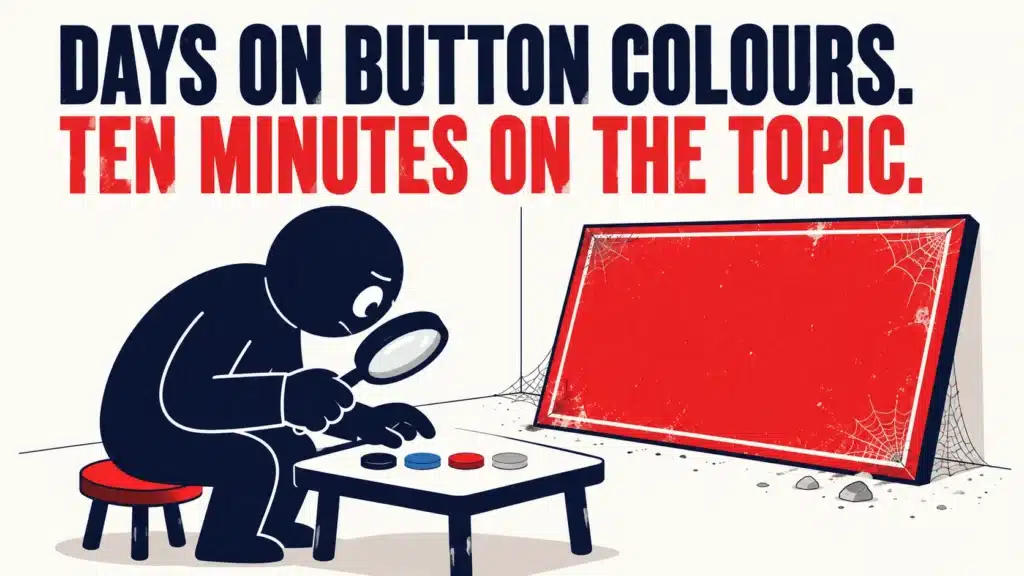
Someone will spend days crafting the perfect ad. They’ll A/B test button colours. Obsess over headlines.
Then when it comes to the actual webinar topic? They slap something together in 10 minutes like an afterthought.
But the topic is where everything starts. If your topic is weak, nothing else matters. Nobody’s going to register for a webinar they don’t care about. And even if they do, they’re definitely not showing up.
Here’s the formula we use:
"Specific Outcome + Time Frame + Remove Objection"
Example: “How to Fill 100 Webinar Seats in 14 Days Without a Big Budget.”
Compare that to: “Improve Your Webinar Lead Generation With These Marketing Strategies.”
One makes you want to register.
The other sounds like a textbook nobody asked to read.
Three types of topics that work:
Outcome topics give a clear, measurable result.
Curiosity topics create a knowledge gap people need to close.
Problem reversal topics flip a common belief on its head — like “How to Trade LESS to Make MORE Money.”
And the worst topics? Purely educational ones. “Let me teach you about marketing frameworks.” Nobody wakes up at 6 a.m. thinking that. They wake up thinking, “I need more customers.”
One more rule: never give away the full answer in the title. Only the promise. We call this the curiosity gap.
Instead of “How to Improve Webinar Attendance with Email,”
try “The Real Reason Your Webinar Attendance Is Low.”
Same topic — but one makes people need to click.
The lesson?
Before you spend a single dollar on ads, test your topic. Post it as a question on social media. If nobody responds, move on to the next one.
Pillar 2: Traffic — Get Them to the Page
You’ve got a killer topic. Now you need eyeballs.
Here’s a truth that might sting: of all four pillars, traffic actually provides the lowest ROI for time spent. You can spend weeks tweaking ads and still get mediocre results. Meanwhile, someone with a solid topic and a decent follow-up system is cleaning up with half your budget.
That said, traffic still matters. We use what I call a marketing channel stacking strategy — layering multiple channels so each one reinforces the others.
Paid Ads: Your ads should NOT try to explain everything. That’s what the webinar is for. Your ad has one job: open a loop that can only be closed by attending. Call out the problem. Tease the outcome. Create curiosity. (For more on this, check out our guide on powerful hooks for webinar marketing.)
Email: If you have a list, don’t blast everyone with the same generic “Hey, I’m doing a webinar” message. Segment your list. Send different angles to different segments. Use curiosity-driven subject lines. We once got over 200 sign-ups and $5K in sales from a single email — it’s all about the approach.
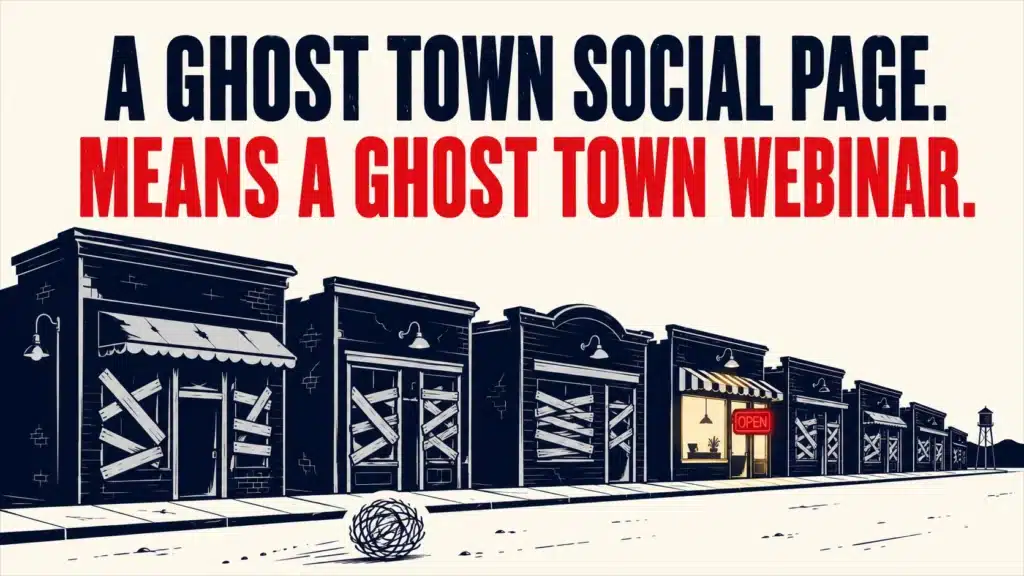
Organic: Your posts, your content, your communities. People who are on the fence about your webinar WILL check your socials. If they look like a ghost town, they’ll assume your webinar will feel the same way. Keep it active. It doesn’t have to be perfect. Just alive.
The lesson?
Stack your channels. And remember — your ad’s job isn’t to teach. It’s to create enough curiosity that people have to register.
Pillar 3: Show Up -
The Most Ignored Pillar (With the Most Leverage)
This is the big one. The pillar almost everyone ignores — and the one that can make or break your entire webinar.
The average show-up rate from paid ads sits around 20-30%. Now imagine bumping that to 50%. You’ve nearly doubled your audience without spending a single extra dollar on ads. Same budget. Way more people in the room. That’s leverage.
So why do most people get this wrong? Because they treat the gap between registration and the webinar like dead air. Someone signs up. Maybe they get a confirmation email. Then… silence until an hour before the event.
That’s like inviting someone to a dinner party and then ghosting them until they’re standing at your door.
Here’s how to fix it.
Start on the Thank You page. This is where you still have their full attention. Affirm their decision. Remind them of the pain you’re going to fix. And get them to take a small action — adding the event to their calendar or downloading a worksheet. That tiny commitment makes them psychologically invested.
Then, your email sequences.
We use three: a Welcome Email (confirm and set expectations), an Indoctrination Sequence (build trust with your story and quick wins before the webinar), and a Reminder Sequence starting three days before the event with teasers, testimonials, and case studies. Every message is not just a reminder — it’s a micro sell. You’re reselling the webinar over and over.
And if you really want to push it further, add WhatsApp or SMS. Done right, this alone can boost show-up rates by 20% or more. Emails get buried. Texts get read. (We’ve also seen great results from using AI to call registrants.)
We once achieved an 84% show-up rate for a client in a tough niche. Industry standard? 30-40%. The difference wasn’t magic. It was this pillar, done properly.

The lesson?
You’re not just reminding people. You’re building anticipation. Every touchpoint between registration and the webinar is a chance to resell the event.
Pillar 4: Convert — Turn Attendees Into Revenue
They showed up. Now what?
This is where most people choke. They deliver 55 minutes of incredible value… then mumble something like, “I hope you got lots of value today. If you want to learn more, please consider my course.”
Please consider.
That’s not selling. That’s apologising for having something to sell.
If you don’t pitch properly, you’re doing your audience a disservice. You just showed them a problem and teased a solution. Leaving them hanging is like a doctor diagnosing a condition and saying, “Anyway, good luck with that!”
Here’s how to structure it.
Hook & Credibility (First 5 Minutes). Answer: Why should they listen to you? Why now? What common problems are you going to address?
Content with Open Loops (70%). Teach and deliver value — but don’t wrap every idea up with a bow. Open loops, close some, then reopen with new ones. This creates tension and keeps people leaning in. It’s the same reason you can’t stop watching a good TV show.
The Pitch (Final 20%). Here’s the trick to making it feel natural: tell them about the offer at the beginning of the webinar. “I’m going to make you an offer at the end. But even if you don’t take it, you’ll walk away with more value than most paid courses.” This removes the awkwardness entirely. By the time you get to the pitch, it’s the natural next step — not a surprise ambush.
And remember: the webinar doesn’t end when you stop presenting. Send the replay. Direct people to a sales page. Create a deadline. A huge chunk of your sales will come afterwards. (Here’s our full breakdown of how effective webinar funnels extend well beyond the live event.)
We helped a property investor go from a 6% to 28% conversion rate by fixing this exact pillar. Same audience. Same offer. Completely different results.

The lesson?
Don’t apologise for selling. Set the offer up early, use open loops throughout, and keep following up after the event. That’s where the real money is.
Where Should You Start?
These four pillars feed each other. If one breaks, the whole engine stalls. But you don’t have to fix everything at once.
Starting from scratch? Nail your topic first (Pillar 1). Everything depends on it.
Already have a list? You need to maximise the ones you have.
Getting good attendance? Optimise your conversion (Pillar 4).
Ready to scale? Now go back and pour fuel on traffic (Pillar 2).
For the full blueprint for marketing a webinar (including the post-webinar system that generates sales for weeks after the event) check this out: High-Ticket Webinar Marketing: The Ultimate Blueprint
FAQs: How to Make Money from Webinars
The 4-pillar framework covers Topic, Traffic, Show Up, and Convert, the four points where most webinars leak profit. Topic uses the formula "Specific Outcome + Time Frame + Remove Objection." Traffic stacks paid ads, segmented email, and organic content. Show Up relies on sequential touchpoints. Convert structures the pitch to follow proven content ratios.
Most webinars don't fail from lack of advertising, they fail from leaks across four areas: a weak topic that doesn't create curiosity, thin traffic from a single channel, low attendance (the average paid-ad show-up rate is just 20–30%), and a pitch structure that isn't optimized to convert attendees into buyers.
Improve show-up rate with a sequence of touchpoints after registration: a thank-you page, a welcome email, an indoctrination sequence, and reminder emails as the webinar approaches. Adding SMS reminders can lift show-up rates by 20% or more. One case study using this sequence reached an 84% show-up rate, well above the 20–30% average.
The average webinar conversion rate is far lower than what's achievable with the right structure. In one documented case, a property investor raised their conversion rate from 6% to 28% by restructuring the presentation: roughly 5 minutes of hook/credibility, 70% content built around open loops, and 20% pitch.
Structure a webinar in three parts: open with 5 minutes of hook and credibility, spend about 70% of the time on content that uses open loops to maintain attention, then close with a 20% pitch. Mentioning the offer early normalizes the sales portion instead of letting it feel like a bait-and-switch.
Ready to Stop Leaking Leads?
I just handed you the same 4-pillar framework we’ve used for over a decade to help coaches build webinars that actually make money.
But reading about it is the easy part.
Building all 4 pillars (the topic research, traffic strategy, webinar lead generation, show-up sequences, conversion system, post-webinar follow-up) that’s where most people get stuck.
Not because they’re not smart enough. But because it’s a lot of moving parts.
If you’re a coach or course creator who wants to scale with webinars but doesn’t want to spend months piecing it together yourself, we might be able to help.
At Radical Marketing, we build and optimise the entire system and we only get paid when our clients get results.