Table of Contents
The Elephant in the Seminar Room
Let’s talk about seminar ad copywriting. Because I think most people are doing this completely wrong, and it’s costing them registrations. (Sorry, someone had to say it.)
Here’s the thing. When you advertise a seminar, you’re not really selling the seminar. Not at first, anyway. You’re selling someone on giving up their evening. Their Tuesday night. Their Saturday morning.
And that’s a HARDER sell than asking for money. Genuinely harder. Try asking your spouse for money versus asking for their Saturday morning and see which one goes down easier…
Think about it. If someone doesn’t like what they bought, they can just… stop using it. No harm done. But if they give you three hours of their life, sitting in a room, listening to a pitch? They can’t get that time back. Ever.
So your seminar ad copy has to work a lot harder than a normal product ad does. It’s basically doing two jobs while a product ad does one.
I’ve written about the full seminar marketing framework here, if you want the bigger picture. But in this post, I want to get specific about seminar ad copywriting. I want to walk you through how to actually write the ads. Almost word by word.
How to Write Ads for Seminars (Start Here, Not With the Headline)
Most people open a blank doc and start typing headlines straight away.
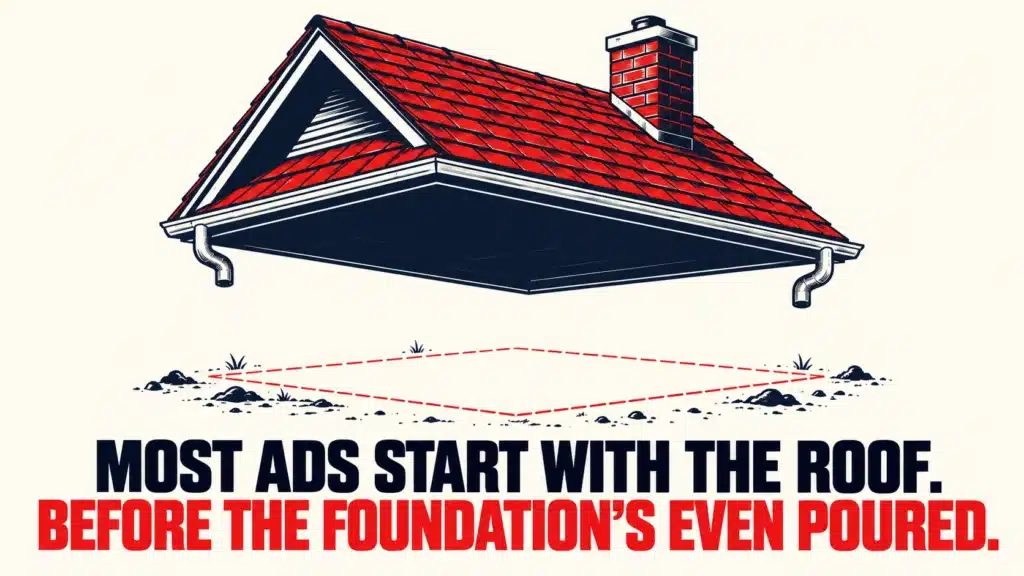
Don’t do that. Seriously, DON’T. I’ve watched people do this for years and it never ends well. It’s like building the roof before the foundation.
Before you write one word of ad copy, you need to know who you’re talking to. Not “business owners.” Not “parents.” That’s far too broad to write anything persuasive against… you’ll end up with mush. Beige, forgettable, scroll-past-it mush.
We build every seminar ad around seven things about the audience:
- Their challenges
- Their pains
- The benefits they want
- Their ultimate desire (the big one, sitting under the small one)
- The common bond that ties this group together
- The emotions behind the decision
- The mechanism, or the “how” that makes your approach different
I go deeper into how to actually dig this research out of a cold audience in this piece on seminar audience research, so I won’t repeat it all here.
But the short version? Good seminar ad copywriting is only as good as the research sitting underneath it.
Write the ad before doing the research, and you’re just guessing. Expensive guessing, too, the kind that quietly drains your ad account while you wonder why nobody’s clicking.
Persuasive Ad Copy for Live Events (Kill the Objections First)
This is the part of seminar ad copywriting most people skip. Here’s why live events are harder to sell than, say, an online course.
People seeing your ad are already sceptical before they’ve even finished reading it. They’ve seen a hundred seminar ads before yours, half of them promising to change their life in a weekend.
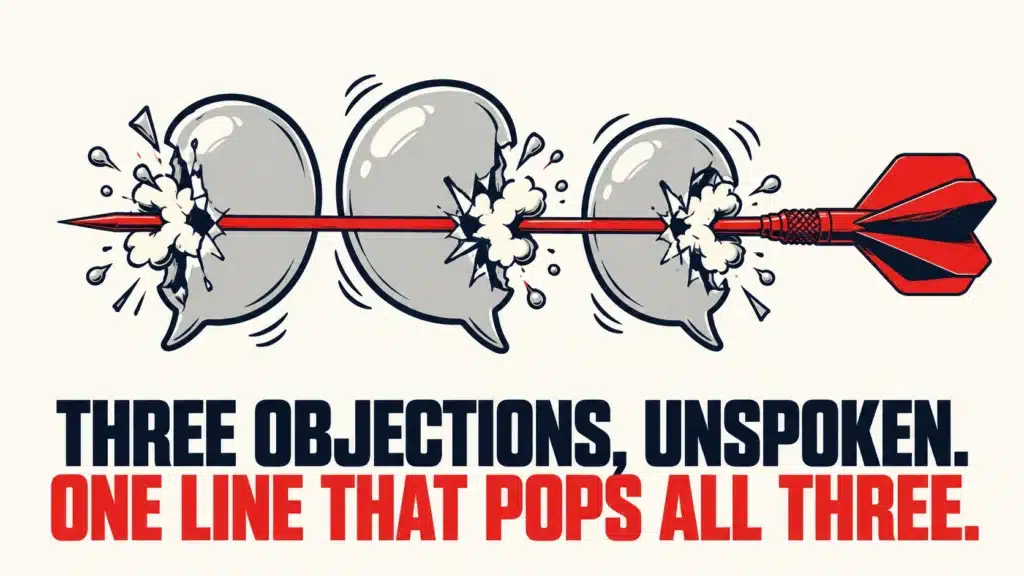
So your copy is fighting objections that haven’t even been said out loud yet. Things like:
- “I’ve tried something like this before. It didn’t work.”
- “This won’t work for my situation.”
- “It’s probably just a pitch for something expensive.”
If your ad doesn’t answer one or two of these, people quietly scroll past. They don’t argue with you. They don’t even blink. They just leave, off to watch cat videos instead.
So your job isn’t only to describe the seminar. Your job is to kill the doubt before it fully forms in someone’s head.
A few ways to do that in the copy itself:
- Name the objection directly (“No, this isn’t another generic seminar about…”)
- Lead with a specific result, not a vague promise (specific numbers beat “amazing results” every single time)
- Use a real proof point, not just a claim of expertise
- End with ONE clear call to action, not three competing ones
That last point matters more than people think. Best practice for calls to action in seminar promotions is simple, really: pick a single action, make the urgency real (actual deadlines, not fake countdown timers that reset every time you refresh the page, we all know that trick by now), and match the language to the funnel stage.
“Register Now” for someone seeing your ad cold. “Save My Seat” once they already know the offer. Vague CTAs like “Learn More” tend to just… sit there, doing absolutely nothing.
On that last point, we have a case study where we generated 1,372 registrations in six weeks, starting from absolute zero.
We also have one where we took a client from 170 to 360 registrations for the same offer, while keeping cost per registration UNDER $10 USD. I won’t walk through the numbers again here, you can read the full breakdown on those pages. But the short version is this. Proof beats adjectives. Every time. No contest.
Seminar Advertising Examples (Templates You Can Actually Use)
Right, examples. This is the practical side of seminar ad copywriting, and people usually skip past this bit. Let’s not.
I’m not going to hand you a swipe file of “here’s an ad that worked,” because honestly? An ad for a property seminar in one country won’t always work for your tuition centre webinar in another.
Context matters too much for that (and also, that’s basically our whole job, so I can’t give ALL of it away here). What I can give you is the structure.
We use a set of headline formulas built around the variables I mentioned earlier. Benefit, Mechanism, Pain, Challenge, that sort of thing. Here’s a stripped-down version:
“How I [Benefit] in [Time Frame] Without [Challenge], Using This [Mechanism]”
Fill that in with your own research and you get something like:
“How I Filled a 200-Seat Room in 6 Weeks Without Spending a Fortune on Ads, Using This One Targeting Trick”
Notice what’s happening there. A specific number (200 seats). A specific timeframe (6 weeks). A named objection getting killed (spending a fortune). And a mechanism that sounds different from what everyone else says (one targeting trick).
That’s really the whole trick to writing compelling headlines for a seminar ad, cram in a number, a timeframe, and a killed objection, and skip the generic “Join Our Amazing Seminar!” nonsense entirely. Nobody has ever registered for anything because it was called “amazing.”
Also, here are two real creative angles worth stealing…
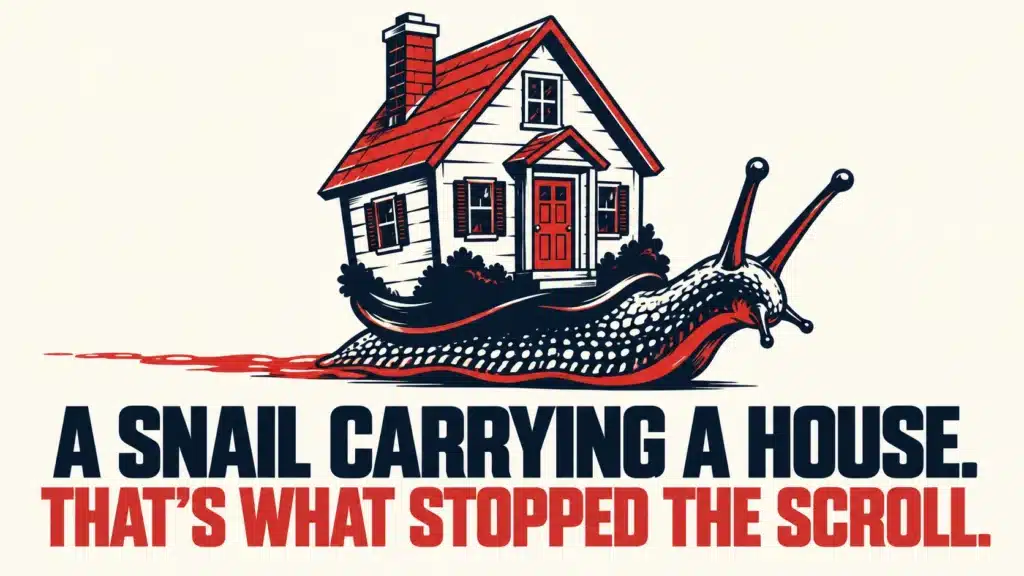
In one campaign, instead of a boring stock photo, we used an image of a snail carrying a house on its shell. The hook was “profit in a slow market.” Unexpected image. It stopped the scroll dead, which, let’s be honest, is more than most seminars can say for their fifteenth “smiling person pointing at a whiteboard” photo.
In another campaign, we tested two completely different angles for the SAME offer. One aimed at people who wanted to quit their job. One aimed at people who just wanted a side income. Same product. Two totally different motivations. Funny how that works, isn’t it?
Facebook Ads for Seminar Promotion (Where Most of the Volume Comes From)
Once your seminar ad copywriting is sorted, the next question is where it runs. For most seminar campaigns we run, Facebook (yes, I still call it Facebook. That tells you how Gen X I am) carries most of the registration volume. So here are a few things worth knowing.
Targeting
If you’ve run a similar event before, even in a different country, that Pixel data is GOLD. Use it to build lookalike audiences. Don’t just guess at interest-based targeting like it’s the 1990s (nobody misses dial-up, don’t bring its targeting strategy back either).
If you have nothing to work from yet, start broad with interests tied to your research. Then narrow fast once you get a small amount of data back.
Ad fatigue is real
If your audience sees the same ad five times, they stop responding to it. Not eventually. Almost immediately! It’s like hearing your favourite song for the hundredth time, at some point you just reach for the skip button.
So you need more than one ad running. Rotate headlines. Rotate images. Rotate the angle. Even if the offer underneath stays exactly the same.
Retargeting isn't optional
Getting the registration is only half the job. People forget. Life gets in the way.
So run ads that specifically target people who already signed up. Just simple reminders. It’s one of the easiest ways to push your turn-up rate higher. Not glamorous, but it WORKS.
Test the landing page too. Your ad copy can be perfect. Genuinely flawless. But if the page it sends people to is generic, or reused from a different offer, you’re leaking registrations right at the finish line, which is a bit like winning the race and tripping over the tape.
Bringing It All Together
So, to recap, because I think this is worth saying plainly. Good seminar ad copywriting isn’t really about clever wordplay. It never was.
It’s about knowing exactly who you’re talking to. It’s about answering their unspoken objections before they even surface. It’s about backing your claims with real proof, not fluffy adjectives.
Then, and only then, you run that message through a Facebook ad system built for testing and retargeting… not just one ad and a prayer.
FAQs: Seminar Ad Copywriting
Every strong seminar ad needs four things: a hook built from real audience research, an objection killed up front, a specific proof point instead of a vague claim, and one clear call to action. Miss any of these and the ad usually underperforms, no matter how polished the headline sounds.
Use a specific number, a specific timeframe, and one named objection you're solving, all wrapped around a mechanism that sounds different from the obvious approach. A formula like "How I [Benefit] in [Time Frame] Without [Challenge], Using This [Mechanism]" forces all three in, instead of something vague like "Join Our Amazing Seminar!"
Keep it to ONE action, not three. Make urgency real, actual deadlines, not fake countdown timers, and match the CTA wording to the funnel stage. "Register Now" suits a cold ad. "Save My Seat" suits someone who already knows the offer. Vague CTAs like "Learn More" rarely convert as well, they're the conversational equivalent of a shrug.
Seminar ads ask people to give up their time, not just their money, and that's often the harder ask. So the copy has to answer doubts and silent objections up front, not just describe the event and list its benefits like a brochure nobody asked for.
General freelance platforms work fine for one-off ad copy, but seminar ad copywriting works best with someone who also understands audience research and Facebook ad ecosystems, not just words on a page. Look for a documented case study with real numbers, not just glowing testimonials, since anyone can write a nice testimonial about themselves.
How Radical Marketing Helps With Seminar Ad Copywriting
Look, I could just say “hire us” and call it a day, but that’s not exactly useful information, is it?
Here’s what actually happens when we build seminar ad copywriting for a client. We start with the same seven-element research I mentioned earlier, then write copy around real objections and real proof, not vague enthusiasm.
From there we build the whole ecosystem: multiple ad variations instead of one lonely headline, a landing page built specifically for the offer, and retargeting to catch people who registered but might not show up on the day.
If you’d rather have us build that system for you than piece it together yourself (no judgement either way, it’s STRESSFUL to manage this on your own), fill out the form below to get a custom build strategy.