Table of Contents
The Hardest Thing You'll Ever Sell
Okay, can I be honest with you for a second?
Selling a seminar is HARD. Like, really hard.
And here’s why. You’re not really asking people for money. Not at first, anyway. You’re asking them for their Saturday.
They have to drive across town. Find parking. Sit with strangers. And they know there’s probably a sales pitch at the end.
That’s a BIG ask, isn’t it?
Honestly, it’s easier to get someone’s money than their time. Ask a friend for twenty bucks, then ask for their Saturday morning. See which one they say yes to faster.
So if you’ve ever stood in front of a half-empty room thinking “where is everyone?”… trust me, you’re not alone.
But here’s the good news. With a SYSTEM, you can fill the room wall-to-wall. Over the years, we’ve boiled our seminar marketing down to five simple steps that work. Again and again.
In this guide, I’ll walk you through all five. And if you want to go deeper on any step, I’ve linked a full post for each one.
Why Seminars Are So Tricky to Promote
If you’re trying to figure out how to promote a seminar, it really helps to know what you’re up against first. Because once you see it, a lot of things suddenly make sense.
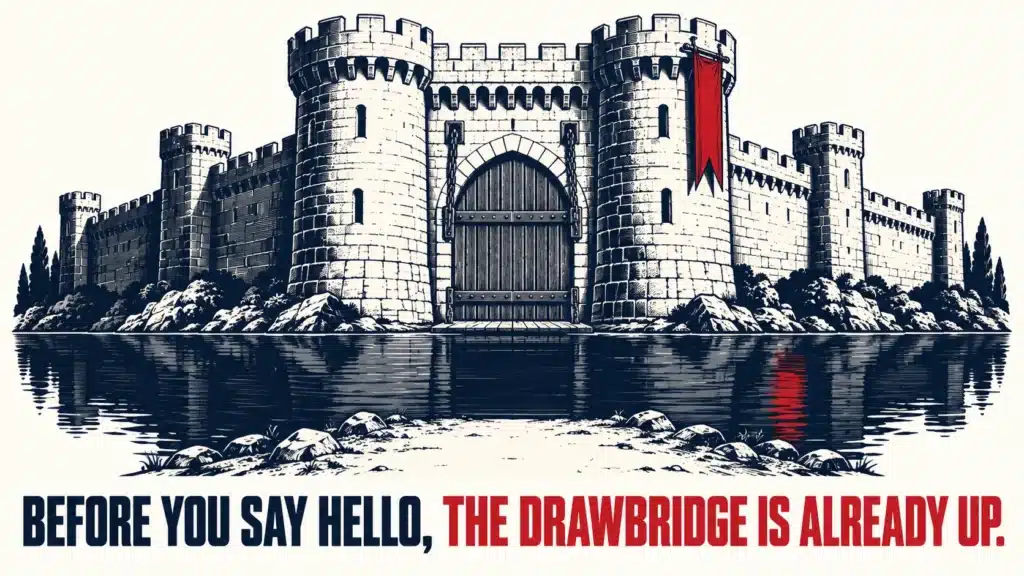
People are already suspicious. They know most seminars end with an offer. So before you’ve even said hello, their arms are crossed.
They’ve heard it all before. In their head, they’re thinking stuff like “I tried something like this and it didn’t work” or “that won’t work for me.” And if your marketing doesn’t deal with those thoughts early? They don’t argue with you. They just… leave.
Everyone’s shouting. These days, everyone’s an “expert.” Your ad is sitting right next to a hundred others, all promising to change someone’s life in a weekend. That’s a LOT of noise.
The clock is ticking. An online course can sell forever. Your event happens on ONE day. If the room isn’t full by then, too bad. That chance is gone.
No wonder so many people struggle. But every one of these problems has a fix. That’s what the five steps are for.
Seminar vs Webinar: What's the Difference?
| 💻 Webinar | 🪑 Seminar | |
|---|---|---|
| Where it happens | Online, from the sofa (maybe in pyjamas) | In REAL LIFE, in a real room |
| How big is the ask? | Small. Super easy to say yes to | BIG. They have to show up in person |
| Staying power | Easy to wander off halfway through and go make a sandwich | Once they're there, they usually stay |
| Commitment | Lower effort, so lower commitment | They made the effort, so they're usually WAY more into it |
| The vibe | Everyone's in their own space | You can FEEL the energy in the room |
All in all, both just do different jobs. If you run online events, our webinar marketing masterclass covers all of that. This guide is about getting REAL people into REAL seats.
The 5-Step Seminar Marketing Strategy That Fills Rooms
Here’s the system. Five steps, in order. And yes, the order matters.
Step 1: Do Your Homework First (Research)
I know. “Research” sounds about as fun as cleaning your room. But this is the step that makes everything else work.
Here’s what most people do. They skip straight to writing ads. BIG mistake. It’s like building a roof before you’ve built the walls. It’s just going to fall down.
So before we write a single word, we figure out seven things about the people we’re trying to reach:
1️⃣ What problems they’re dealing with
2️⃣ What’s really bugging them (their pains)
3️⃣ What good things they want
4️⃣ Their BIG dream (the one hiding under the small one)
5️⃣ What they all have in common
6️⃣ How they feel about all of it
7️⃣ What makes your way different from everyone else’s
Get these right, and your ads almost write themselves. Get them wrong, and you’re just guessing. And guessing gets expensive. Fast.
For a deeper dig on audience research, check out our guide to seminar audience research.
Step 2: Write Ads That Answer Doubts Before They Pop Up
This is where loads of seminar ads go wrong.
Most people just describe the event. “Join us for an amazing evening!” Then they’re confused when nobody clicks.
Remember, the people seeing your ad are already a bit suspicious. So your ad has TWO jobs. First, grab their attention. Second, answer the doubts quietly floating around in their head.
Here’s what helps:
1️⃣ Say the doubt out loud. Something like “No, this isn’t another boring property seminar.”
2️⃣ Use real numbers. “360 sign-ups” beats “amazing results” every single time.
3️⃣ Show proof. Don’t just say “we’re experts.” Show what you’ve actually done.
4️⃣ Ask for ONE thing. Not three. Just one clear button to click.
And here’s a fun one. Don’t be scared to be a little weird. In one campaign, we used a picture of a snail carrying a house on its back.
The ad was about making money in a slow property market. Odd? Sure. But people stopped scrolling to look at it. And that’s the WHOLE point.
I explain all of this (plus some headline formulas you can steal) in our post on seminar ad copywriting.
Step 3: Run a Team of Ads, Not Just One
Here’s a mistake I see ALL. THE. TIME.
One ad. One offer. Fingers crossed.
But one ad can’t do everything. It’s like asking one football player to be the striker, the defender, AND the goalkeeper.
So we build a whole team of ads instead. We call it an ad ecosystem. Each layer has ONE job:
🟢 Layer 1 reaches total strangers who’ve never heard of you.
🟢 Layer 2 goes back to people who were interested but didn’t sign up yet.
🟢 Layer 3 reminds people who DID sign up to actually show up.
That last one? Almost everyone forgets it.
And honestly, I think it might be the most important. For one client, simple reminder ads helped push their turn-up rate from around 30% to past 40%. Some campaigns even went OVER 50%.
All three layers are explained in our 3-step seminar ad ecosystem guide.
Step 4: Let Robots Do the Boring Stuff
Okay, not actual robots. But you get what I mean.
If you’re doing everything yourself, YOU are the bottleneck. Answering messages at midnight. Typing names into spreadsheets. Sending reminder texts one at a time.
So we automate it. There are four main pieces:
1️⃣ A landing page that matches your ad and makes signing up super easy.
2️⃣ Automatic emails and texts that confirm, remind, and keep track of everyone.
3️⃣ A short on-demand webinar that lets people get to know you before you ask for their whole day.
4️⃣ A chatbot that answers questions any time of day. Yes, even “is there parking?” at 2am.
But here’s one warning…
⚠️ Automation makes things faster. It doesn’t make them better.
If your message is wrong, automation just sends the wrong message to more people. Faster. That’s why this is step four, not step one.
Want the full breakdown? Read our post on seminar funnel automation.
Step 5: Protect Your Reputation With Every Ad
This last step is what keeps you around for the long run. We call it brandvertising. (Brand plus advertising. Get it?)
Here’s the problem. A lot of seminar ads are super pushy and full of hype. “Make a MILLION dollars in 30 days!” You’ve seen them. We all have.
Sure, they get clicks. But they make people trust you less. And they fill your room with people who were never going to buy anyway.
So here’s how we see it. The feeling your ad leaves behind matters just as much as the click. Every campaign should make people trust you MORE, not less. Because you’re not just running one event. You’re building a business.
How to Get Seminar Attendees Who Actually Show Up
| What to do | What it looks like |
|---|---|
| 1. Remind them | Ads, emails, and texts that keep your event in their head right up until the big day. |
| 2. Attract the right people | Good research and good ads bring in people who really want what you're teaching. Not just people looking for a free afternoon out. |
| 3. Make it easy | Quick confirmations. Clear directions. Answers to their questions before they even ask. |
Does This Actually Work? Two Real Examples
Fair question. Anyone can make a list of steps. So let me show you what this looks like in real life.
Example 1: From zero to 1,372 sign-ups
This client had no funnel, no email list, and only six weeks until their first event. Yikes.
So we borrowed data from their events in another country to find similar people to target. We used weird, scroll-stopping pictures (yep, the snail again).
We sent emails about big news everyone was already talking about. And we built brand-new landing pages from scratch.
The result? 1,372 registrations in six weeks, in a really crowded market.
Example 2: Doubling sign-ups for the same event
A stock market training company was getting about 170 sign-ups per event, at around $20 USD each. Not bad! But they were stuck.
After we took over, sign-ups jumped to 360. And a year later? We were still getting close to 350 per event, at UNDER $10 USD per sign-up.
We actually had to stop spending more on ads, because the venue only had 200 seats (plus an overflow room).
You can read the full 170 to 360 story here.
Live Event Marketing for Speakers
If you're a speaker, coach, or expert, there's one more thing to think about. YOU are the product.
People aren't just asking "is this topic worth my time?"
They're asking "is this PERSON worth my time?"
So live event marketing for speakers has to do more than sell the event. It has to help people trust YOU. Here's how…
Show your face
Use videos. Let people hear how you talk before they meet you.
Teach them something first
A short on-demand webinar or a helpful blog post lets people try you out before they give up a whole day.
Protect your reputation
This is where brandvertising really matters. Hype might fill ONE room. Trust fills rooms for years.
Bringing It All Together
So let’s do a quick recap. The seminar marketing system we use to fill rooms comes down to five continuous steps executed in exact order.
First, you have to deeply research the exact audience you want to reach.
Once you know who they are, write ads that directly answer their doubts and showcase undeniable proof.
Next, build a complete team of ads designed to reach new prospects, follow up consistently, and send timely reminders.
To scale your efforts without losing your sanity, automate the repetitive tasks so the entire machine runs smoothly in the background.
Above all, protect your reputation with every single ad you put into the marketplace.
Do them in sequence. Don’t skip the boring parts. And remember, a full room isn’t luck—it’s a system.
FAQs: Seminar Marketing Tactics
Seminar marketing is how you promote a live, in-person event so the right people sign up and actually show up. It usually covers research, strong ad copy, a team of ads that work together, automation like landing pages and reminders, and protecting your reputation with every ad.
Start with research, so your money only goes towards the right people. Then write one strong ad that answers a real doubt, send people to a simple landing page, and set up automatic reminders. Small budgets work best when every piece is aimed at the right crowd.
Remind them. Ads, emails, and texts keep your event in their head right up until the day. For one client, reminder ads helped lift turn-up from around 30% to past 40%, and some campaigns went over 50%. Clear directions and quick answers help too.
It depends on what you want. Webinars are easy to say yes to and can reach people anywhere. Seminars are a bigger ask, but people who show up tend to be more committed because they made the effort. You can also use a webinar to warm people up for a seminar.
It depends on your market and where you're starting from, but it doesn't have to take years. In one campaign, starting from zero with no list or funnel, we got 1,372 registrations in six weeks by combining research, eye-catching ads, timely emails, and brand-new landing pages.
How Radical Marketing Handles Your Seminar Marketing
We’ve been helping speakers, coaches, and experts fill their seminar rooms since 2014. We’ve worked with clients in Australia, Asia, Europe, the UK, and the USA. And this is the five-step system we use to fill their rooms.
If you’d rather have a team build it all for you (no judgement, it’s a LOT to handle on your own), take a look at our seminar marketing services.
Or book a chat below and let’s plan your next event together.