

Table of Contents
Stop Guessing, Start Filling Rooms
Right, let’s talk about the bit everyone skips.
When most people set out to fill a seminar room, they jump straight to the fun part. The ad copy, the images, the offer, all of that. Because that’s the exciting bit, isn’t it? You want to see something happening.
Research, on the other hand, sounds boring. It sounds like homework nobody asked for.
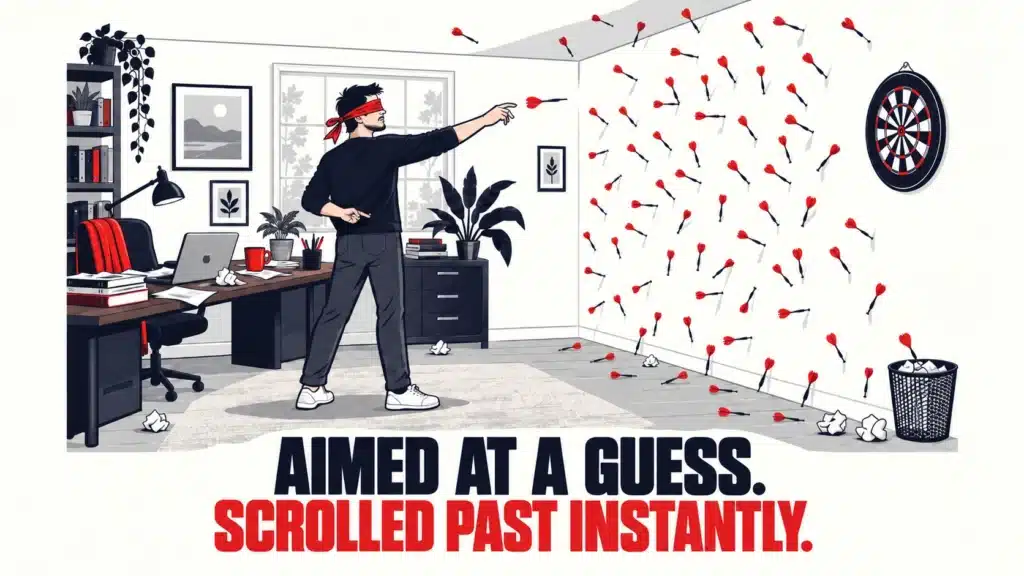
But here’s what actually happens when you skip it. You write an ad you love from your desk, but your audience scrolls right past because it was built on a guess, not real data.
Sound familiar?
Or you keep changing things, the headline, the image, the offer, and the numbers just sit there. Flat. No matter what you tweak.
If you’re trying to figure out why no one’s signing up for your events, read this blog. I promise it’s usually not your ad platform and it’s not your budget. Nine times out of ten, it’s simply that you skipped step one: proper seminar marketing audience research.
What Is Seminar Marketing Audience Research, Actually?
Here’s the simple version.
Seminar marketing audience research is the process of mapping out what your ideal attendee actually thinks, feels, and wants, before you write a single word of ad copy.
Not “oh, I reckon they probably want this.” Actual, specific, written-down answers.
Do this properly and your ad copy stops being a guess. It becomes a match. You already know what to say, and pretty much how to say it, before you open a blank document.
Skip this step and you’ll get vanity metrics: likes, clicks, zero registrations. No headline tweak can fix an ad if you didn’t do the homework first.
The 7 Elements Framework
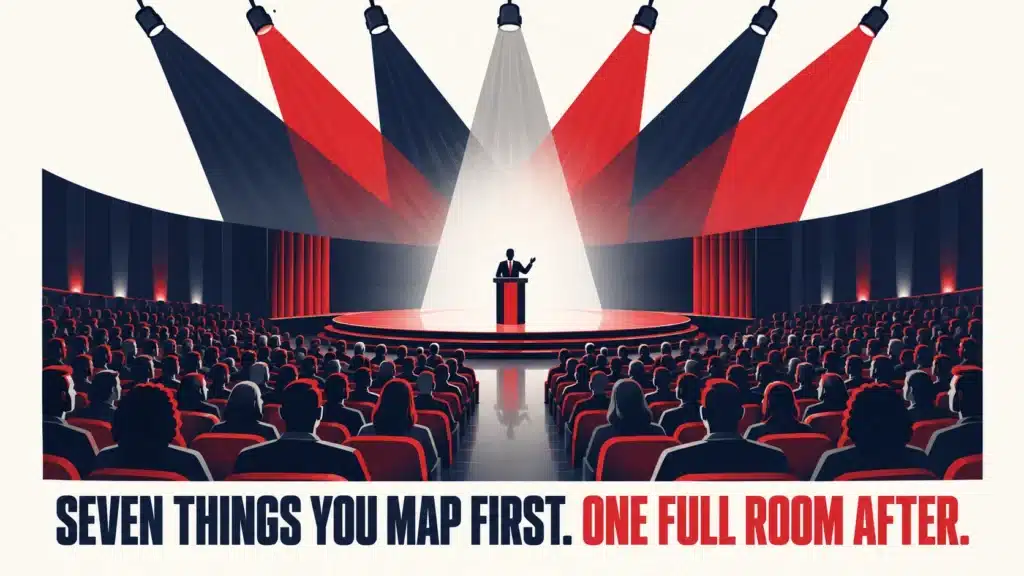
Before we touch targeting, before we even think about the offer, this is where proper seminar marketing audience research actually happens: mapping seven specific elements underneath every single person in the audience.
Let’s go through them properly, because I actually want you to use this. Not just nod along and forget it by Friday.
1. Challenges
This is the practical problem standing in their way, right now…
“Struggling in business” is too vague, honestly, it tells you nothing.
“Lost three good staff this year because there’s no career path to offer them,” now THAT’S a challenge.
Specific. Usable. Something you can actually write about.
2. Pains
People mix this up with challenges constantly.
The challenge is the practical problem. The pain is what that problem feels like at 2am. Using the same example, the challenge is the sales team missing targets. The pain is lying awake doing payroll maths in your head, or feeling embarrassed in front of your own team because you don’t have an answer for them.
Pains are emotional. Skip them, and your ad sounds logical, sure, but it’s never going to hit anyone in the chest.
3. Benefits
Not features. Nobody, and I mean nobody, cares that you’ll teach them “our 5-step system.”
What they care about is the OUTCOME.
Something more like: “you’ll walk into your next board meeting with an actual plan, and for once, you’ll feel confident about it.”
4. Ultimate Desire
This is the big one. Honestly, it’s the one most people miss completely.
Someone coming to a business seminar might tell you straight up, “I want more sales.” Fair enough.
But dig one layer deeper, and the ultimate desire is often something like freedom. Actually being able to take a holiday without the business falling apart while they’re gone. Or security. Knowing their family’s looked after if something happens to them.
The surface goal gets the click. The ultimate desire gets the commitment.
5. Common Bond
What connects this audience to each other? Could be a shared background, everyone being a first-generation business owner, say. Could be a shared struggle: everyone’s tried and failed with the same method before.
Nail this properly and your ad stops sounding like marketing. It starts feeling like you’re talking directly to their tribe.
6. Emotions
How is someone feeling when they see your ad? Frustrated, because they’ve already tried everything? Hopeful, because something recently happened that made change feel possible?
This matters a lot, because the exact same message lands completely differently depending on where someone is emotionally.
7. Mechanism
The specific method that actually gets someone from where they are to where they want to be.
Stop offering vague promises like “we teach marketing.”
Give people a clear, named framework they can see. Because here’s the thing: people buy real systems, not promises. It builds trust instantly.
How Do You Actually Find This Stuff Out?
Fair question. Here’s how we actually go about it, no big budget required.
Customer interviews.
If you’ve run seminars before, or sold anything at all to this audience, get on a call with a handful of past attendees.
Ask open questions. What was going on for you before you decided to sign up? What almost stopped you from registering?
Don’t lead them to an answer. Just let them talk, and take proper notes.
Sales call recordings.
This one’s massively underused.
Go back and listen to your own sales calls or consultation recordings, if you’ve got them. The exact words your prospects use to describe their problem are usually sitting right there, in recordings you’ve never actually gone back and listened to properly.
If five different people describe their problem using almost the same words, that’s not a coincidence. That’s your ad copy, sitting there, waiting for you.
Surveys.
Short ones. Two or three specific questions sent to your list or past attendees can surface patterns fast.
Keep it short though, because long surveys just don’t get finished. People give up halfway.
Competitor research.
Go look at what competitors are saying in their ads, and read their comment sections, especially the complaints. People will openly tell you their frustrations in a comment section in a way they’d never say to your face on a sales call.
Kind of funny, actually, how honest people get when they think nobody important’s reading.
Your own comments and DMs.
If you’re already running ads or putting out content, this is a goldmine sitting right in front of you, and most people never go back and read through it properly.
Why This Actually Works (A Real Example)
Let’s look at a real one, because talking in theory only gets you so far.
We worked with a client running stock market training seminars here in Malaysia.
Before we came in, they were getting around 170 registrations for their preview events, spending roughly USD 20 per registration. Not bad, right?
But the client wasn’t really struggling with cost. Their funnel already worked fine. They just needed more people going into it.
So we went back and did the research properly.
Looked at who was actually showing up. Built better targeting off the back of that, using lookalike audiences and retargeting, instead of just broad interest-based targeting like they were doing before.
End result? We more than doubled their registrations to 360, and brought the cost per registration down at the same time.
Wasn’t a one-off fluke either. We ran the same approach the following year and kept hitting 300+ registrations consistently. Attendance climbed too, from around 30% up to over 40%.
All of it came from understanding the audience properly first, and then building targeting and messaging around that.
A Quick Word of Caution
I want to be straight with you about something.
This isn’t a five-minute job. Real seminar marketing audience research takes proper thinking, working through all seven elements for your specific audience. It’s not something you can fake by guessing what sounds about right.
Rush it, or assume you already know your audience without actually digging in, and you’ll end up with an ad that sounds fine on the surface but just doesn’t convert. Built on assumptions, not actual research.
And this isn’t a one-time checklist you write once and never look at again. It should shape every ad, every headline, every bit of messaging you put out for that seminar.
Basically, all of it.

Bringing It All Together
Before writing a single word of ad copy, map your audience across the seven elements: challenges, pains, benefits, ultimate desire, common bond, emotions, and mechanism.
Gather real answers using interviews, sales call recordings, surveys, competitor research, and comment sections.
And while this is step one of our system for seminar marketing specifically, the exact same approach works just as well for coaching, SaaS, or webinars.
No matter what you sell, your messaging has to meet people right where they actually are.
If you want the full picture of how this fits into everything else, our seminar marketing pillar guide walks through the entire five-step system this framework belongs to.
FAQs: Seminar Marketing Audience Research
Seminar marketing audience research is the process of identifying what your ideal attendee thinks, feels, and wants before you write any ad copy. It covers seven elements: challenges, pains, benefits, ultimate desire, common bond, emotions, and mechanism.
Use resources you already have: interview past attendees, listen back to sales call recordings, send short surveys, study competitor ads and comment sections, and review your own social comments and DMs. None of it requires paid tools.
A challenge is the practical problem someone faces, such as a sales team missing targets. A pain is the emotional weight of that problem, such as the stress of running payroll numbers at 2am. Both need mapping separately.
Ads usually fail when they're written from assumption rather than research. Without mapping the audience's real challenges, pains, and desires first, the messaging misses the mark even when the offer itself is genuinely strong.
The seven elements stay the same for both. What changes is the delivery format, not the psychology. Whether someone's registering for a physical room or a webinar, they still need to feel understood before they'll commit. See our webinar marketing approach for how this applies online.
How Radical Marketing Helps With Seminar Marketing Audience Research
This is genuinely the part of the job we enjoy most, if I’m honest.
At Radical Marketing, this exact process, mapping the seven elements and gathering real answers, is step one of the way we build out seminar campaigns for clients.
It’s also step one for our webinar marketing work, because whether someone’s filling a physical room or a Zoom call, the underlying psychology doesn’t change. People still need to feel understood before they’ll register.
If you’d rather not build this out alone, or you want a second pair of eyes checking the research before it turns into ad spend, that’s exactly what we do.
Head over to our seminar marketing page to see the full five-step system this fits into, or get in touch if you’d like us to build it out for your business.