

Table of Contents
Stop Expecting One Ad to Do Three Jobs
Here’s a pattern I see all the time.
Someone has a seminar coming up. They write one ad. They point it at one offer. Then they sit back and wait for the room to fill.
And… it doesn’t.
Or it does for about a week. Then the cost per registration creeps up, and up, and up, until it’s eating the whole margin.
Now, I don’t think the ad is usually the problem. Honestly, the ad might be fine! The problem is that one ad is doing ALL the work.
It’s trying to catch cold strangers. It’s trying to win back the people who nearly signed up. And it’s trying to get registrants to actually turn up on the day.
That’s three different jobs. One ad can’t do all three well. Nobody could.
So instead, we build a seminar ad ecosystem. A group of ads that each do one job, and pass people along from one to the next.
In this post, I’ll walk you through how that works, layer by layer. If you want the big picture of how we fill seminar rooms, it’s all on our seminar marketing page.
And if you’re new to all this, start with our complete guide to seminar marketing first.
Why One Ad, One Offer Doesn't Work for Seminars
Seminars are a hard sell. You’re asking people for their time, not just their money.
But here’s the thing people miss…not everyone who sees your ad is in the same place.
The copywriter Eugene Schwartz called this the levels of awareness.
Some people don’t even know they have a problem yet. Some know the problem but not the fix. Some have heard of you. And some are nearly ready to say yes.
One ad can only talk to one of those groups. Everyone else? They scroll right past.
Then there’s the other problem. Every ad wears out. Show people the same ad enough times and they stop seeing it. Not slowly. FAST.
So with one ad, you get a short burst of results… then a slow, expensive slide.
What Is a Seminar Ad Ecosystem?
A seminar ad ecosystem is a set of ads, built for different stages of your buyer’s journey.
Cold ads open the door. Retargeting ads bring back the curious. Reminder ads get registrants into their seats.
Each ad has ONE job. That’s really the whole idea.
We mix formats too. Image ads, video ads, all running across the main ad platforms your audience uses. That way people see you more than once (in more than one way) without seeing the same thing over and over.
On the webinar side of our business, we call this the Radical Ad EcoSystem. It’s the same thinking we use in our webinar marketing services, just adapted for people who have to leave the house and sit in a physical room.
The 3 Layers of a Multi-Ad Strategy for Live Events
Here’s how I’d break down a multi-ad strategy for live events. Three layers. Three jobs.
Layer 1: The First Handshake (Cold Audiences)
This is for people who’ve never heard of you. Your only job here is to stop the scroll and get the click.
The mistake most people make? They test one idea with tiny tweaks. A different button colour. A slightly different headline. That’s not testing, my friend. That’s fiddling.
We do the opposite. We call it Blitzvertising. We launch lots of fresh, genuinely different ideas at once. Then we find the winners fast, and try to beat them.
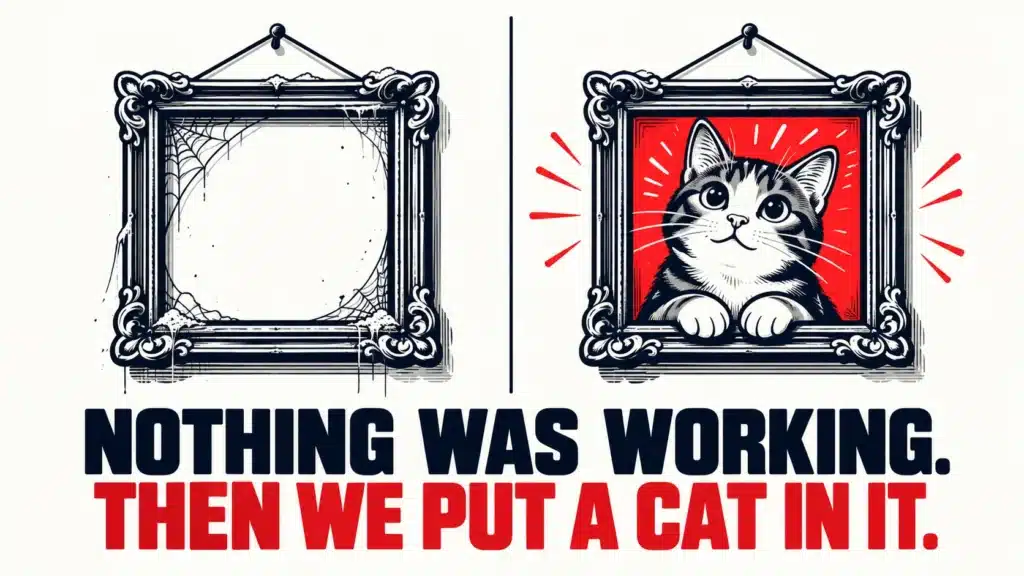
Here’s a real one. We had a campaign for a high-ticket coaching client in Malaysia that was dying. We tried new headlines. Different images. New audiences. Nothing. Zilch.
Then our ads manager said, “You know what? Put a cat in it.”
So we did. And the cost of showing the ads dropped, and sales started coming in.
(Malaysians LOVE cats, by the way. Here’s the full story.)
Layer 2: The Second Look (Warm Audiences)
Most people won’t register the first time they see you. That’s normal. They click, have a look, and then the kettle boils or the kids need something.
This is where retargeting ads for seminars earn their keep. These ads go to people who watched your video, clicked your ad, or visited your page… but didn’t sign up.
These people already know who you are. So don’t show them the same cold ad again! Give them something new. Answer the doubt that stopped them. Show them proof.
(Our guide to seminar ad copywriting covers how to write copy that kills objections.)
Here’s a real example. We worked with a stock market training company in Malaysia. They were getting about 170 registrations per event at roughly $20 USD each.
After we added lookalike audiences and started retargeting warm leads, registrations jumped to 360. And the cost per registration went DOWN, not up.
A year later, we were still bringing in close to 350 registrations at under $10 USD each. You can read the full case study here.
To be fair, retargeting wasn’t the only change. We also rotated new angles and tested constantly. But it was a BIG part of it.
Layer 3: The Nudge (Registered, But Not in the Room Yet)
This is the layer almost everyone forgets. And I think it’s the most important one.
Because a registration isn’t a butt on a seat. People sign up, then life happens. They forget. They get tired. Netflix calls.
So we run reminder ads to people who have already registered. Just simple ads reminding them the event is coming up.
For that same stock market client, turn-up was around 30% when we started. With reminder retargeting, we pushed the average past 40%. In some campaigns, OVER 50%.
Those simple reminder ads did most of the heavy lifting.

Keeping Your Seminar Ad Ecosystem Fresh
Here’s the thing. Building your seminar ad ecosystem once isn’t enough. It needs looking after.
Ads wear out, remember? So you keep rotating. New headlines. New images. New angles. Even when the offer stays exactly the same.
And when something works, you don’t just leave it running forever. You try to beat it. Nothing goes on autopilot. NOT EVER.
How Many Ads Do I Need for My Seminar?
This is one of the questions I get asked most. How many ads do I need for my seminar?
Honestly? There’s no magic number. Anyone who gives you one without knowing your audience is guessing.
But you can work it out. Here’s a simple way to think about it:
1️⃣ Cold layer: a few different angles, each in more than one format.
2️⃣ Warm layer: a few ads that answer doubts and show proof.
3️⃣ Registered layer: a small set of reminder ads leading up to the day.
So say your research turns up 2 strong angles. You run each one as an image ad and a video ad. That’s 4 cold ads already.
Add a couple of warm ads and a couple of reminders, and you’re at around 8. Plus fresh ones as the old ones wear out.
Now, before you run off and make 50 ads… don’t. It’s all about having the RIGHT ad for each stage.
An Ad Ecosystem Marketing Framework You Can Start With
If you want a simple ad ecosystem marketing framework to get going, here’s a checklist:
☐ Do your audience research first. No research, no angles.
☐ Write several cold ads with genuinely different angles.
☐ Make each one in at least two formats, like image and video.
☐ Set up retargeting for people who clicked or visited but didn’t register.
☐ Give those warm ads a new message: proof and objection-busting.
☐ Set up reminder ads for everyone who registered.
☐ Check your numbers often. Replace tired ads before they drag costs up.
Why a Group of Ads Beats One Hero Ad
So, let’s recap…
One ad, one offer is a gamble. It might work for a week. Then it wears out, and your costs climb.
A group of ads fixes that. Cold ads open the door. Retargeting ads win back the curious. Reminder ads get people into the room. And you keep refreshing all of it, so nothing goes stale.
Remember, it’s about the right ad, for the right person, at the right time. Get that right, and filling your next seminar gets a whole lot less stressful.
FAQs: Seminar Ad Ecosystem
A seminar ad ecosystem is a group of ads where each one has a single job. Cold ads reach new people. Retargeting ads bring back people who showed interest but didn't register. Reminder ads help registrants actually turn up. Together, they move people from stranger to seated attendee, instead of relying on one ad to do everything.
One ad can only speak to one type of person, and people see your ad at very different stages. Some have never heard of you. Others nearly registered last week. On top of that, every ad wears out. Once people have seen it a few times, they stop responding, and costs start to rise.
There's no fixed number. It depends on how many strong angles your research finds. A simple starting point is a few cold ads in two formats, a couple of warm retargeting ads, and a small set of reminder ads. Then add fresh ads as older ones wear out and stop performing.
Yes, they can make a big difference. For one of our clients, turn-up sat at around 30% before we started. After we ran reminder ads to people who had already registered, the average rose past 40%, and some campaigns went over 50%. Simple reminders did most of the heavy lifting.
Yes. Start smaller rather than skipping layers. Test fewer angles in the cold layer, but still run warm retargeting and reminder ads. These later layers catch people who already know you and nearly said yes. Cutting them to save money usually costs you more in lost registrations and empty seats on the day.
How Radical Marketing Builds Your Seminar Ad Ecosystem
Look, you can absolutely build this yourself. But if you’d rather have a team that’s been filling seminar rooms since 2014 do it for you… that’s what we do.
We start with deep research. We build every layer: cold, warm and reminder. Then we keep testing and refreshing, so your costs don’t creep up while you’re busy running your business.
Because at the end of the day, it’s all about one thing. Putting butts on seats.
If that sounds useful, have a look at our seminar marketing services, or book a chat below and let’s map out your next event.