Table of Contents
Testimonials are easy to write. Numbers are a lot harder to hide behind.
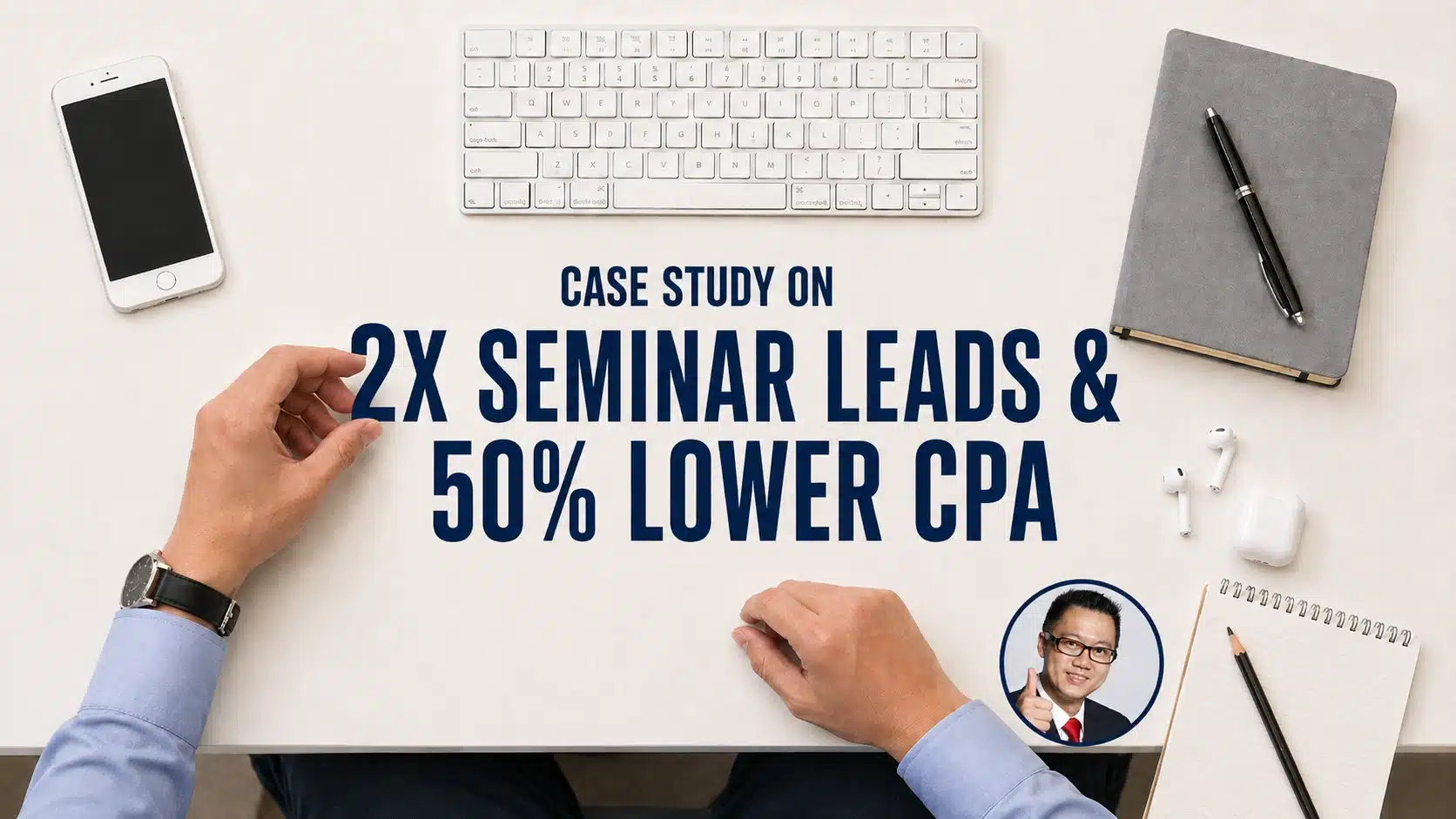
So for once, we’re pulling back the curtain on one of our longest-running accounts to share a case study on seminar marketing in action for a stock market investment training company based in Malaysia.
Their model is straightforward: get people into a free preview event, then offer a US$2,000 training programme at the event itself. Simple funnel.
The HARD part was filling the room, again and again, without the cost per registration eating the margin…
Watch here:
Where We Started
Before we came on board, the client was running Facebook Ads in-house.
To be fair, they were NOT doing badly. They brought in about 170 registrations for a single preview event at roughly $20 USD per sign-up. When you are selling a $2,000 backend offer, that is a solid baseline.
The problem was not the cost. It was the CEILING.
They had tried tweaking campaigns on their own but hit a wall. The funnel worked, but as this case study on seminar marketing demonstrates, it needed a steady stream of new people flowing through it.
The Turnaround
Once we took over, registrations for a single event jumped to 360, more than double their starting baseline!
At the same time, the cost per registration dropped.
Getting higher volume at a lower cost is not the usual trade-off, but the new setup made it happen.
Proving It Was Not Just a Fluke
A single good campaign can easily be a fluke. So let us look at a campaign we ran over a year later for the exact same client and offer in this case study on seminar marketing.
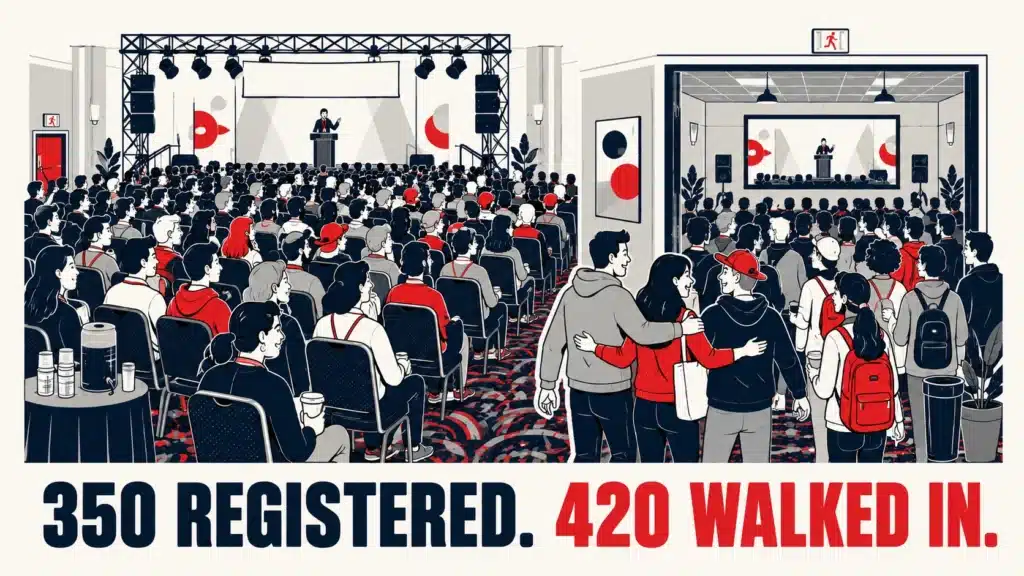
Registrations came in close to 350. We actually could have pushed for more, but we had to cap the budget because of room capacity! The venue held 200 seats, with an overflow room on a live video feed for anyone else.
Cost per registration had crept up slightly, mostly because the ad auction became more competitive over the year. More advertisers bidding naturally drives up costs across the board.
Even so, as highlighted in this case study, the cost stayed UNDER $10 USD per sign-up, which is still a fantastic return against a $2,000 offer.
Plus, that 350 figure is actually modest. Real attendance ended up closer to 420 once you count people who brought friends or came in through word-of-mouth referrals that never touched an ad…
Getting People to Actually Show Up
Getting the registration is only half the job. Getting people to walk through the door on the day of the event is where most campaigns fail.
When we started, the client’s turn-up rate was around 30%. We managed to push that average past 40%, and in some campaigns, OVER 50%.
Our biggest lever was reminder retargeting. Instead of letting people forget they signed up, anyone who registered started seeing follow-up ads reminding them about the upcoming date.
We used a few other tricks, but those simple reminder ads did most of the heavy lifting.
What We Actually Changed
It came down to three core shifts detailed in this case study of seminar marketing:
1. Ad Copy and Angles
Before writing a single word, we did DEEP research to really understand who we were talking to.
The hook “quit your job and invest” appeals to some people, but plenty of others just want a reliable side income without leaving their career. It is the same product, but two totally different motivations.
Once our research mapped those angles out, we constantly rotated new headlines and visuals to keep things fresh.
Audience fatigue is real: if people see the same ad five times, they tune it out!
2. Smarter Targeting
The client had only been targeting basic interests. Based on our audience research, we introduced lookalike audiences and retargeted warm leads, which INSTANTLY improved efficiency.
3. Continuous Testing
We constantly split-tested ad copy, visuals, and landing page layouts against our initial research insights. Nothing was ever left on autopilot.
The Bottom Line
Facebook Ads work exceptionally well, but as every case study on seminar marketing proves, it is NEVER a “set it and forget it” project.
It requires ad copy that evolves, targeting that gets sharper over time, and a real strategy to get registered attendees into physical seats.

FAQs: Case Study on Seminar Marketing (Using Facebook Ads)
Cost per registration depends on competition in Facebook's ad auction, but a well-run campaign can keep cost per registration well under the price of a single backend sale...often single digits to low double digits in US dollars, even against a high-ticket offer like a $2,000 training programme.
Many campaigns see registration to attendance ratios around 30% without any follow-up. With consistent retargeting to remind registrants before the event, that ratio can be pushed past 40%, and in stronger campaigns, past 50%... roughly a third MORE people actually showing up on the day!
Ad performance naturally declines through ad fatigue, where audiences see the same creative repeatedly and stop responding. Ongoing testing of new headlines, angles, and hooks against each other keeps a campaign performing well past its first few weeks. A standard finding in any case study on seminar marketing.
The same offer can appeal to different people for different reasons. One hook might attract someone wanting to quit their job, while another in the same audience just wants a second income. Writing ad copy before understanding that distinction risks alienating half the potential audience with a single message.
Interest-based targeting alone tends to plateau. As seen in this case study on seminar marketing, layering in lookalike audiences (built from existing registrants or customers) and retargeting audiences typically drives a larger share of the efficiency gains than interest targeting can achieve on its own.
Let Radical Marketing Handle the Heavy Lifting
Running profitable events shouldn’t feel like a constant gamble with your budget…
With our targeted Seminar Marketing Service, we build and manage end-to-end campaigns designed to fill your rooms with ready-to-buy attendees.
If you’d rather have an experienced team manage the whole funnel for you, reach out TODAY and let’s discuss if we’re a good fit.