
Table of Contents
One Number Won't Tell You Anything
Someone asked me last week: “Terence, is 200 registrants good?”
Wrong question.
Registrants don’t pay invoices. Attendees don’t either, not on their own. Revenue does.
And revenue is the last stop on a four-stage journey that most webinar hosts only ever look at from one angle.
Here’s the thing about webinar performance metrics: there’s no single number that tells the whole story. It’s a chain.
Registration leads to attendance. Attendance leads to conversion. And conversion (or the lack of it) leads to follow-up. Follow-up decides how much “lost” revenue actually comes back.
Look at only one link in that chain, and you’ll misdiagnose the problem every single time.
…Low attendance gets blamed on a “bad list” when it’s actually a commitment problem.
…Low conversion gets blamed on “cheap leads” when the webinar itself never earned the sale.
…And missing revenue almost always gets blamed on “the offer” when the real issue is nobody followed up properly.
This post is the diagnostic. A map of the webinar performance metrics that actually matter at each of the four stages, what a healthy number looks like, and exactly which of our other guides to read the moment you find the leak.
The Four Stages of Webinar Performance
Think of your webinar funnel as four checkpoints.
Each one either passes people through to the next stage or loses them for good. These are the webinar performance metrics worth tracking, in the order they actually happen:
- Registration → Attendance. Did the people who signed up actually turn up?
- Attendance → Conversion. Of the people in the room, how many bought on the day?
- Non-Buyers → Recovered Revenue. Of the people who didn’t buy, how many came back and bought later?
- Your Numbers → Benchmarks. Are your figures at each stage actually good, or are you panicking over numbers that are completely normal?
Most coaches obsess over stage two. Almost nobody audits all four. That’s the gap this post closes.
Stage 1: Registration → Attendance
This is where most webinar problems start. It’s also the one hosts spot last.
Say you get 200 people to register. Then only 90 show up on the day. Most hosts think: “My list is bad.” Wrong. The list isn’t the problem.
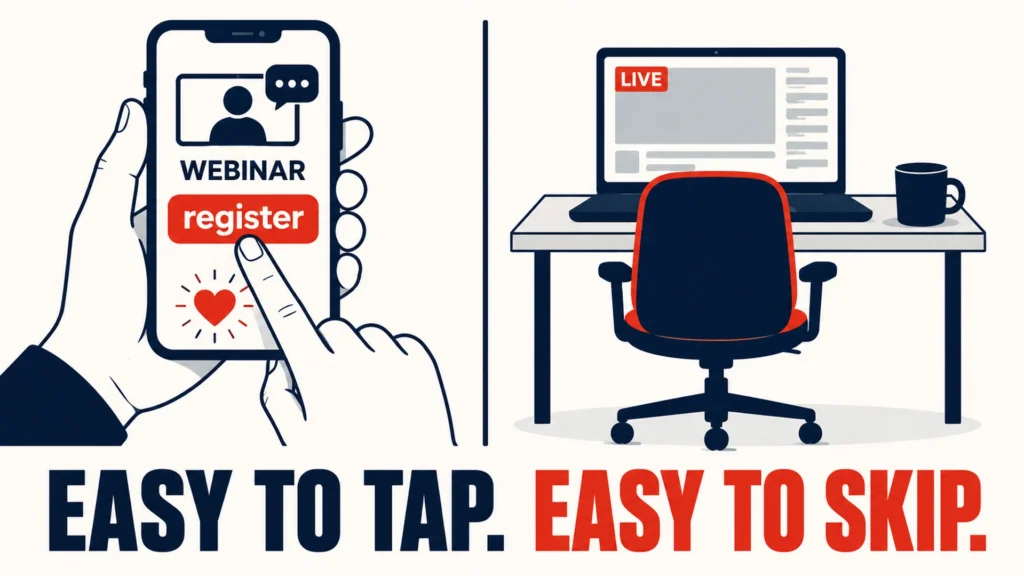
Signing up and showing up are two different things. Signing up takes five seconds. It’s as easy as liking a photo on Instagram. It doesn’t mean the person is actually planning to be there.
So the fix isn’t “send more reminder emails.” The fix starts the moment someone signs up. It’s what you show them on the registration page. It’s what you show them on the thank-you page. It’s every email between sign-up day and webinar day.
➤ We’ve written the full guide on this. The Show-Up Formula covers five simple ways to turn a casual sign-up into someone who actually turns up.
Quick check: if not enough people are showing up, don’t touch your reminder emails first. Look at your registration page instead. That’s usually where people drop off.
Stage 2: Attendance → Conversion
Somebody shows up, sits through the whole thing, and still doesn’t buy. Frustrating? Yes. Surprising? It shouldn’t be.
Knowing how to turn webinar attendees into paying customers starts with understanding why they didn’t buy in the first place.
There are only ever four reasons:
- You taught instead of convinced them,
- The offer felt bolted onto the end,
- They didn’t trust the price,
- They simply weren’t ready that day.
Three of those four are fixable inside the webinar itself. The fourth (timing) is fixable too, just not on the day. More on that in Stage 3.
Here’s the number that matters at this stage: profit per attendee, not attendance.
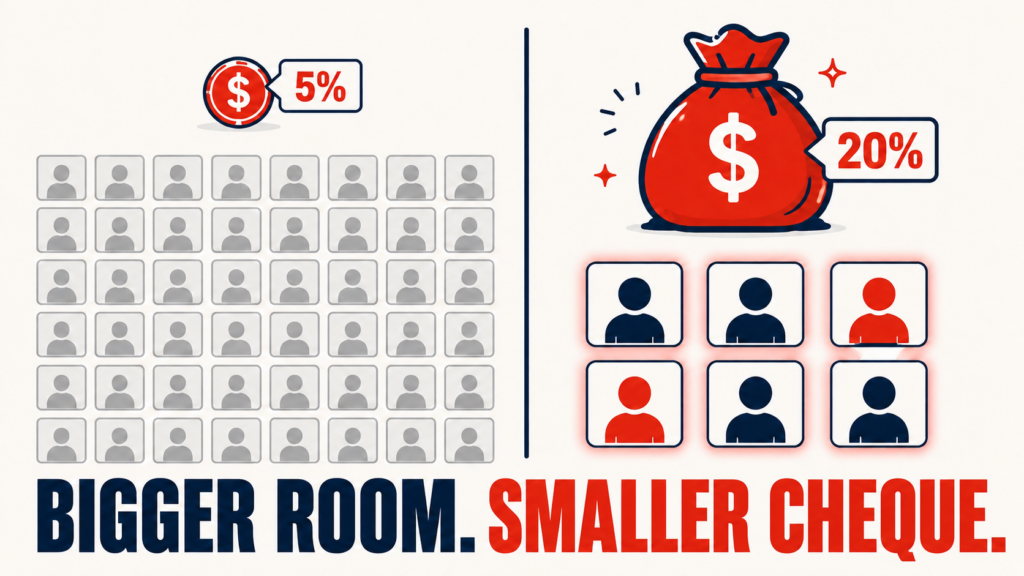
A packed room that converts at 5% is often worse than a small room that converts at 20%. Full rooms feel good, but they don’t pay the ad bill on their own.
➤ The full breakdown of why people sit through your entire pitch and still say no (and what to do about each reason) is here: Webinar Conversion Rates: How to Convert Webinar Attendees.
Quick self-check: if attendance is healthy but conversion is flat, the problem isn’t your traffic. It’s what happens between minute one and the pitch.
Stage 3: Non-Buyers → Recovered Revenue
Here’s the stage almost every webinar host skips. It’s also the one with the most money hiding in it.
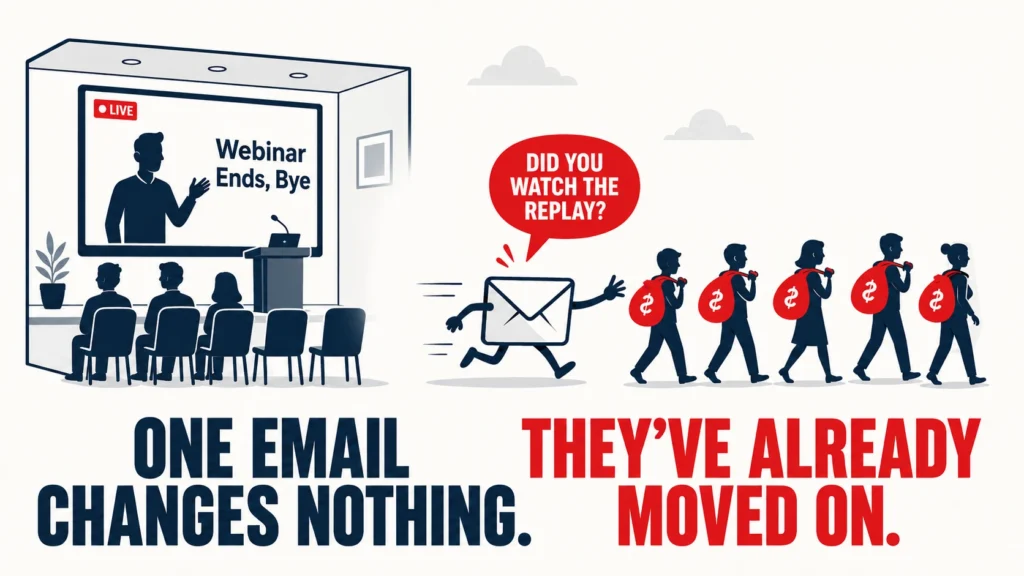
On the day, only 5% to 20% of attendees buy. That means 80% to 95% of the room leaves without paying. Most hosts write all of them off. They think: “Not interested.”
They’re wrong.
Ever heard of the 10-80-10 rule? Around 10% were always going to buy. Another 10% were never going to. But the 80% in the middle? They just weren’t ready yet. Life got in the way. Their card was in another room. They wanted to sleep on it first.
What you do in the next 21 to 30 days decides how many of that 80% actually buy.
Send everyone the same boring “did you watch the replay?” email, and you’ll win almost none of them back.
But split people into groups (no-shows, people who left early, people who watched it all but didn’t buy, and buyers) and send each group the right message.
Do that, and you can add 30% or more revenue from the exact same webinar. No extra ad spend.
➤ For the full email sequence, with subject lines and templates for each group, read:The Post-Webinar Email Sequence That Recovers Lost Sales.
➤ For the bigger system behind it (where an AI chatbot and your email list fit in), read: Perpetual Profit Engine Part 4: The Autonomous Conversion Protocol.
Quick check: did your webinar go well on the day, but revenue still feels thin a month later? This is almost always where the leak is.
Stage 4: Your Numbers → Benchmarks
You can’t diagnose a leak in a chain you don’t understand.
Before you panic over any number in stages one to three, you need to know what “normal” actually looks like and which webinar metrics drive revenue versus which ones just look nice on a slide.
A few numbers worth knowing before you decide something’s broken:
- Warm-audience show-up rates typically sit between 40% and 57%. Cold traffic to paid ads? Often 15% to 30% and that’s fine, not failing.
- Most webinars pull fewer than 100 live attendees. A small, qualified room regularly outperforms a big, unqualified one.
- A common conversion benchmark is around 22% of attendees taking a desired action, though this shifts hard depending on your price point.
Comparing your numbers to the wrong benchmark is how good funnels get “fixed” into worse ones.
➤ Before you touch anything, check where you actually stand: Webinar Benchmarks for 2026: Attendance, Conversion, and Engagement Statistics That Matter.
How to Improve Webinar Performance: See the Whole Chain, Not Four Separate Problems
Here’s why this matters as a whole picture and not four separate problems.
Say your show-up rate is a healthy 45%. Your on-the-day conversion is a respectable 12%. But three months later, your revenue per webinar still feels flat compared to what it should be.
Look at each stage in isolation and everything looks… fine?
Nothing’s obviously broken. But look at the full chain, and the gap is obvious: you’re doing nothing with the 88% who didn’t buy on the day.
That’s not a Stage 1 or Stage 2 problem. It’s sitting entirely in Stage 3 and no amount of tweaking your registration page or your pitch will fix it.
This is the real answer to how to improve webinar performance: treat it as one funnel, not a single metric. It tells you where to spend your next hour of work, instead of guessing.
➤ If you want the full architecture for how these stages fit together as a system (not just the diagnosis, but the build), we’ve mapped it out in The Three Zone Webinar Funnel.
➤ And if you’re starting from scratch, the Webinar Marketing Masterclass is the full hub everything on this site ties back to.
The Bottom Line
Your webinar isn’t one number. It’s four.
Attendance tells you if people showed up.
Conversion tells you if the webinar itself did its job.
Follow-up tells you if you left money on the table.
And benchmarks tell you whether any of that is actually a problem, or just normal.
Check only one of these, and you’ll keep fixing the wrong thing.
Look at the whole chain instead, and the fix gets obvious fast.
You’ll stop guessing and go straight to the stage that’s actually leaking.
Fix that one thing, and watch the same traffic, the same webinar, and the same offer bring in more revenue than it did last time.
That’s what webinar performance metrics are for. A map, not a report card.
FAQs: Webinar Performance Metrics
Webinar performance metrics are the numbers that show how well a webinar turns registrants into paying customers. That includes your attendance rate, your on-the-day conversion rate, and how much revenue you recover from non-buyers afterwards.
The three metrics that matter most are attendance rate, on-the-day conversion rate, and post-webinar recovered revenue. Track only one of these (usually attendance) and you'll miss where the real problem is.
Good attendance only tells you the first stage of your funnel is working. If conversion is also weak, the webinar itself isn't earning the sale. If conversion is fine but revenue still feels thin, the leak is almost always in your follow-up, not the live event.
No, a low webinar conversion rate is not automatically a bad sign. A £5,000 programme converts differently to a £197 course, and cold traffic converts differently to a warm list. Compare your numbers to the right benchmark for your price point and traffic source before assuming something's broken.
A 30% uplift in post-event sales from the same webinar is a fairly normal result once follow-up is segmented properly by attendee behaviour. That's revenue from leads you already paid to acquire, with no extra ad spend needed.
Radical Marketing Helps You Get More People to Show Up
Reading about webinar performance metrics stage by stage is one thing. Actually finding out which stage of your funnel is leaking (and fixing it) is another.
That’s what we do at Radical Marketing.
We look at your registration-to-revenue numbers as one connected system, not four separate reports, and tell you exactly where the money’s disappearing.
If you want us to take a proper look at your funnel, check out our webinar marketing services.
Or if you’d rather just talk it through, book a strategy session with us.