

Table of Contents
Stop Comparing Your Webinar Against The Wrong Numbers
Most webinar hosts think they’ve got a webinar problem. When in reality, they’ve got a benchmarking problem.
They look at their attendance rates, conversion rates, or engagement numbers and assume something is broken.
Then the panic starts. Headlines get rewritten. Slides get rebuilt. Registration pages get redesigned. Sometimes all in the same afternoon.
The issue?
A lot of the webinar benchmarks people still quote today come from studies that are, frankly, older than they should be. In internet years, that’s basically ancient history.
And yet, they’re still being used as gospel.
The webinar landscape has changed. Audience behaviour has changed. Webinar technology has changed. Even expectations have changed (people now expect less “lecture”, more “don’t waste my time”).
So if you’re comparing your webinar marketing performance against outdated data, you might not be fixing a broken funnel…
You might just be optimising the wrong one.
And that’s where things get interesting.
So, let’s look at the webinar benchmarks that actually matter in 2026.
Webinar Attendance Benchmark:
What Is a Good Show-Up Rate?
This is usually the first question people ask when looking at webinar benchmarks.
“What is a good webinar attendance rate?”
Short answer: it depends.
Slightly longer answer: it really depends on your audience.
According to recent industry reports, webinar attendance rates for warm audiences typically fall between 40% and 57%.
That’s a fairly wide range, but it actually makes sense once you stop treating all webinars like they’re identical twins.
Enterprise B2B webinars often sit at the higher end of that range because registrants are already deep in an active buying process.
In some cases, they’re even required to attend (which is less “opt-in interest” and more “corporate attendance policy”… but we’ll let that slide).
For coaches, consultants, course creators, and service businesses, attendance rates tend to sit closer to the middle of that range.
Now cold traffic is a different story entirely.
If you’re running paid ads directly to a webinar registration page, webinar show-up rates often drop to around 15% to 30%.
Which, on paper, looks slightly depressing.
But in reality? It’s completely normal.
People forget. Calendars get messy. Priorities shift. Someone’s confident “I’ll be there” on Monday turns into “I’ll watch the replay” by Wednesday… which usually means never.
The mistake most marketers make is assuming lower attendance automatically means something is broken in their funnel.
It doesn’t.
A webinar attendance benchmark only becomes useful when you understand the context behind it – your traffic source, your market, and your offer.
Without that context, you’re basically comparing apples to very confused oranges.
And this is exactly why webinar benchmarks matter in the first place. Not to judge performance blindly, but to understand what normal actually looks like before you start optimising.
If you want to improve your webinar attendance rates, there’s a breakdown of the systems we use to increase registrations and show-up rates in the video linked below.
Watch here:
Spotify listeners, tune in here:
Apple Podcasts listeners, tune in here:
Most Webinars Are Smaller Than You Think
Here’s a statistic that surprises many people.
The majority of webinars attract fewer than 100 live attendees.
And yet, this is where things get interesting.
Because many marketers judge performance using completely misaligned webinar benchmarks, usually borrowed from large-scale launches or polished industry events with budgets (and audiences) most businesses don’t have.
So when they see 50 or 70 attendees, the reaction is often panic.
“Something’s wrong.”
“This didn’t work.”
“Should we rebuild everything?”
In reality, those numbers are completely normal.
A webinar with 70 highly qualified attendees can easily outperform a webinar with 500 unqualified registrants. Yes – smaller room, better outcome. Not glamorous, but effective.
This is where webinar benchmarks start to get misunderstood. People focus on volume instead of value.
But webinar attendance rates are only one part of the picture.
The real question isn’t how many people showed up.
It’s whether the right people actually did.
Because webinar attendance benchmark discussions are almost meaningless if they ignore audience quality and that’s where most optimisation efforts quietly go wrong.
The Best Day & Time To Host A Webinar
Usually it’s something like: “Tuesday works best for us” or “No one shows up on Fridays”, typically based on vibes, not data.
The DATA is far more useful than opinions.
Recent webinar engagement statistics suggest that Wednesday consistently produces the highest webinar attendance rates, with Thursday close behind.
When it comes to timing, 3 PM tends to generate the strongest attendance performance across industries.
That said, not every audience behaves the same way.
A webinar aimed at business owners may perform very differently from one targeting HR professionals or in-house marketing teams who may or may not be secretly multitasking in another tab.
But if you’re starting from scratch with no historical data, Wednesday or Thursday at 3 PM is a sensible place to begin testing.
It’s not magic. It’s just the most statistically forgiving starting point.
And this is where webinar benchmarks become useful again, not as strict rules, but as directional signals when you don’t yet have your own data to rely on.
Another interesting trend is seasonality.
January consistently performs strongly for webinar attendance rates.
People return from the holiday period with new goals, fresh budgets, and a slightly more optimistic belief that this will be the year everything gets sorted.
For businesses using paid traffic, January can also offer lower advertising costs compared to the highly competitive final quarter of the year, when everyone is fighting for attention (and auction prices start behaving like they’ve had too much coffee).
So while webinar benchmarks won’t give you a perfect formula, they do give you a starting framework, and in webinar marketing, that alone saves a lot of expensive guesswork.
Webinar Engagement Statistics:
Why Interaction Matters
Many webinars fail for a surprisingly simple reason: they feel like a presentation instead of a conversation.
Or worse, a very long monologue with slides.
The strongest webinar engagement statistics all point toward the same conclusion: interactive webinars consistently outperform passive ones.
And this is where webinar benchmarks start to shift from being about attendance and timing… to what actually happens inside the session.
Features such as polls, Q&A sessions, live chat, and audience reactions aren’t just “nice additions”, but they directly influence outcomes.
Yet many webinar hosts still treat engagement features as optional. Something to switch on if there’s time. Or if they remember. Or if the platform default didn’t scare them into ignoring it.
That’s a mistake.
Every interaction creates a small psychological commitment from the audience.
When attendees participate, they become more invested in the presentation.
They’re paying attention.
They’re processing the information.
They’re quietly thinking, “I’ve already engaged… I may as well stay.”
This is one reason why webinars that actively use engagement tools often generate significantly higher webinar conversion rates than those that don’t.
It’s not complicated. It’s behavioural.
And once you understand that, webinar benchmarks stop being abstract numbers and start becoming a reflection of how involved your audience actually is.

Webinar Conversion Rates:
What Does Good Actually Look Like?
Let’s talk about the metric everyone really cares about.
Webinar conversion rates.
Or, in plain English: “Did this actually make me money?”
A common benchmark is around 22% of attendees taking a desired action.
That action might be:
- Booking a strategy call
- Requesting a demo
- Applying for a programme
- Making a purchase
- Scheduling a consultation
However (and this is where most people get this wrong) context matters.
A webinar selling a £197 course will naturally convert very differently from one promoting a £5,000 consulting engagement. One is impulse-friendly. The other requires trust, timing, and usually a bit more life admin.
Comparing those webinar conversion rates directly doesn’t make much sense. It’s like comparing a coffee shop queue to a luxury car showroom and wondering why people behave differently.
This is exactly where webinar benchmarks get misinterpreted. People look at the number without understanding the environment behind it.
What’s more interesting is the role engagement plays in conversion performance.
Webinars that actively use engagement tools consistently outperform those that don’t.
Why? Because engagement creates momentum.
Every question answered, poll completed, or chat message submitted increases audience involvement.
And involvement drives action.
People don’t just watch their way into decisions. They participate their way into them.
So if your webinar conversion rates are lower than expected, don’t immediately assume the offer is the problem.
Start by looking at what your audience actually did during the session. Because more often than not, the issue isn’t the offer. It’s the lack of interaction that should have led to it.

How Long Should A Webinar Be?
For years, marketers have debated the ideal webinar length.
Most webinars still run at around 60 minutes, which on paper sounds perfectly reasonable.
But here’s the part people tend to overlook: average engagement rarely lasts that long. People start dropping off before the end, long before the “final big moment” arrives.
That creates a very predictable issue.
Many hosts spend most of the session building value, only to place their offer right at the end. In theory, it makes sense. In practice, a fair chunk of the audience never actually sees it.
So the most important message ends up sitting in the section of the webinar that…
well, didn’t really get watched.
Not ideal.
This is where webinar benchmarks can be a bit misleading if you only look at duration in isolation. On paper, 60 minutes is still the standard. In reality, attention behaves in a far less cooperative way.
And this is why webinar benchmarks only become useful when they’re read alongside engagement behaviour, not just structural averages.
The takeaway is fairly simple:
Don’t bury the offer at the end and hope everyone patiently waits for it. Place key insights, proof, and calls to action while people are still actually paying attention.
The Most Overlooked Part Of Every Webinar Funnel
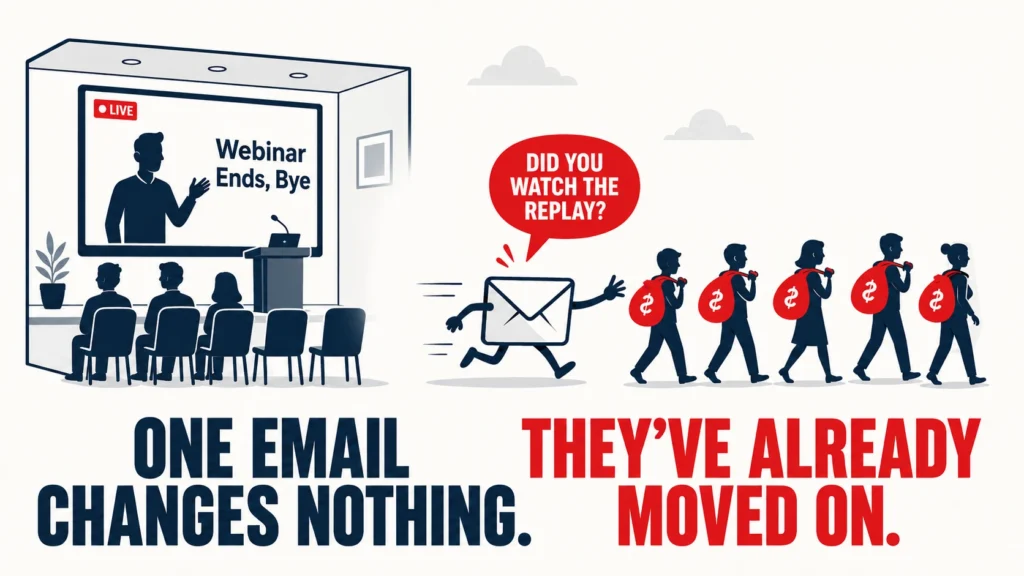
Many businesses treat the webinar as the finish line.
It’s not.
In actuality, it’s often just the start of the sales process, which is where most webinar benchmarks start to get misunderstood.
One of the most consistent findings across webinar attendance benchmarks is that no-shows don’t automatically mean lost opportunities.
Most people don’t skip intentionally. They forget. Something urgent comes up. Or they fully intend to watch the replay later and then get distracted by… life doing what it does best.
This is why follow-up carries so much weight.
In fact, post-webinar emails often outperform standard marketing emails, with higher open rates and stronger click-through rates.
Yet this is usually where effort drops off.
The biggest mistake isn’t failing to get people to register, but it’s treating the webinar like the end of the journey.
The highest-performing funnels don’t. THEY SEGMENT.
Attendees get one message. No-shows get another. Clickers who didn’t convert get something different again.
And that’s where webinar benchmarks stop being theoretical and start becoming operational because the real performance lift often happens after the live session has already ended.
Done properly, this is where webinars stop being “events” and start becoming systems that keep generating revenue in the background.
What These Webinar Benchmarks Mean For Your Business
The most important thing to remember is that webinar benchmarks are just averages.
They’re a starting point, not a target.
If your webinar attendance rates sit between 40% and 57% for warm audiences, you’re generally within benchmark.
If your webinar conversion rates hover around 20% or higher, you’re likely performing reasonably well.
If your audience actively participates through polls, chat, and Q&A, you’re already ahead of many webinar hosts.
In the end, benchmarks simply tell you where the floor is. Not where you should live.
Your systems determine how far above that floor you can actually climb.
Currently, the businesses that win with webinars won’t necessarily be the ones with the biggest audiences.
They’ll be the ones with the strongest attendance, engagement, conversion, and follow-up systems.
FAQs: Webinar Benchmarks
For warm audiences, a good webinar attendance rate typically falls between 40% and 57%. For webinars promoted through cold traffic and paid advertising, attendance rates are often lower, ranging from 15% to 30%.
These numbers don’t exist in isolation though. Webinar structure and format can also influence attendance performance before optimisation even begins (we break this down here).
Average webinar conversion rates vary depending on the offer, audience, and industry. However, a common benchmark is around 22% of attendees taking a desired action, such as booking a call, requesting a demo, or making a purchase.
Recent webinar benchmark data suggests that Wednesday tends to produce the highest attendance rates, with Thursday also performing well. However, businesses should test different days and times based on their target audience.
Most webinars run for 45 to 60 minutes. Research shows that audience engagement often declines before the end of the presentation, so important content and calls to action should be delivered before a significant drop-off occurs.
Webinar engagement statistics help measure how actively attendees participate during a webinar. Features such as polls, live chat, Q&A sessions, and audience reactions have been shown to improve engagement and can contribute to higher conversion rates.
Ready to Improve Your Webinar Performance?
At Radical Marketing, we help businesses build and scale webinar funnels that generate qualified leads and sales.
From webinar marketing services and paid advertising to registration pages and follow-up sequences, we design systems built to outperform standard webinar benchmarks, not just hover around them hoping something eventually clicks.
If your webinars feel like they’re “not bad… just not quite there yet”, that’s usually a systems problem, not a motivation problem.
Get in touch with us, and we’ll break down your funnel properly – what’s working, what’s quietly leaking results, and what needs to change so your webinars actually start doing their job.