The Problem With Most Webinars (And Why Yours Can Be Different)
Most webinars fail.
Not because the content sucks—they’re probably brilliant!
But that doesn’t mean a thing if nobody shows up.
Or worse… they show up, stay for five minutes, then ghost you forever.
Here’s the truth:
Webinars can be a goldmine for scaling your business. But only if they’re marketed right. The thing is, most people are still marketing them like it’s 2020 (when everyone and their dog were attending webinars).
That’s why most webinars today attract a room full of crickets.
Now, here’s why that’s great news for you.
See, we at Radical Marketing haven’t just been sitting on our bums. We’ve spent the past few years helping our clients scale their businesses and rack up six, even seven-figure paydays from their webinars. 💰
Now, we’ve distilled everything we’ve learned into a battle-tested blueprint you can steal.
And you, my friend, are reading it.
Let’s dive in.
Step 1: Start with the End Goal
Before you even THINK about running a webinar, ask yourself:
Will this webinar make me money?
Too many coaches and consultants obsess over slides, tech setups, and fancy animations—while completely ignoring the only thing that matters: Does this webinar convert?
A great webinar isn’t just a presentation. It’s a sales machine.
So first things first, you should go through this checklist:
An Irresistible Offer – Have you gotten any sales with your offer? Do people actually find your offer ‘fair’ or ‘reasonable’? Does it solve a problem that your audience is desperate to fix? If so, you can tick this.
A Clear Ideal Client – Do you know who your ideal client is – the people most likely to buy your offer? Do you know about their demographics, their psychological data, their behaviours and interests? If you are able to build a detailed and accurate customer avatar of your ideal client, then you can tick this off.
A Relatable Topic – Anyone can do a webinar. But not everyone can come up with a topic that people actually care about. Does your webinar topic resonate with your target audience? Is it fresh and interesting instead of something that’s already been recycled by countless others over and over again? Then mark this bad boy ‘complete’.
An Achievable Promise – What are you promising your audience? What will they get once they finish attending your webinar? Ideally, this should be separate from your actual offer (e.g., you promise to solve one problem by the end of the webinar… but introduce an offer that helps solve a different problem later on). If that promise is clear AND achievable, tick this off.
If you can confidently check all four above, it’s time for some tweaks.
Step 2: Understand the Webinar Funnel
Marketing a webinar isn’t about slapping together some ads and hoping people show up. It’s about guiding them through a journey—from “Who the heck are you?” to “Here’s my credit card.”
That journey is called a webinar funnel.
The 5 Key Phases of a High-Performing Webinar Funnel:
- Awareness – Get your webinar in front of the right people through a mix of organic and paid strategies. This includes social media content, blog posts, YouTube videos, JV partnerships, and targeted ads.
- Registration – Convincing them to sign up. Write a compelling, benefit-driven webinar landing/registration page, make the sign-up process easy, use scarcity and urgency to drive immediate action, and offer bonuses to incentivise more sign-ups.
- Pre-Webinar Nurture – Warm your prospects up so they actually show up (and show up excited & ready to buy!) – send engaging reminders that build anticipation, host pre-webinar sessions, and provide free checklists, workbooks or other materials to keep them interested.
- Live Webinar – Deliver an engaging, persuasive experience that smoothly transitions into your pitch.
- Post-Webinar Follow-Up – Where most of your sales actually happen.
Miss any of these steps, and you’ll be left wondering why your webinar flopped.
Now, the more astute of you might have noticed that I said that ‘post-webinar follow-up’ is where MOST of the sales actually happen…
And yes, that’s actually true.
On average, 70% of people DON’T buy during the webinar itself.
The good news is that if you have a great funnel, you can get more sales from the 70% who didn’t convert. Want a deeper breakdown of how webinar funnels work? Read this.
Now that you’ve familiarised yourself with the basics of a high-performing webinar funnel, it’s time to proceed with the next step!
Step 3: The Webinar Landing/Registration Page
Imagine this: Someone sees your webinar ad, thinks “Hmm, this looks interesting,” clicks… and then lands on a snooze-fest of a landing page.
What do they do? They leave.
And you get nothing.
A weak landing page will kill your webinar before it even starts.
See, your landing page is a sales page and they’ve got one job: Get people to sign up.
So it’s time to create a kickass landing page.
The 5 Key Phases of a High-Performing Webinar Funnel:
❌ Weak, forgettable headlines – “Join My Webinar!” might as well say “Move along, nothing to see here.” It’s vague, it’s generic, it’s not compelling at all.
❌ Too much fluff – A 20-paragraph backstory about your journey? Nobody cares.
❌ No testimonials… or too much – Testimonials are great! But if you have too much crammed in without care for context or design, it’s not going to look very convincing.
❌ Badly optimised – If your landing page is slow to load or isn’t optimised for both desktop and mobile… you’re putting money on the table.
❌ Zero urgency – A simple “Register Now” as your CTA? Meh. They’ll click on it later… or never.
What A High-Converting Webinar Landing Page Looks Like
✅ It has a punchy, benefit-driven headline.
✅ It’s clean, easily readable, and easy to digest.
✅ Only keeps the most impactful testimonials to avoid clutter.
✅ Speedy, well-optimised for both desktop and mobile.
✅ The CTA hints at scarcity and urgency instead of a generic ‘Register Now’
If your webinar landing page is underperforming, then chances are, you just need to make a few simple tweaks here and there.
Even two or three of these changes can make a MASSIVE difference.
If you want to see this in action, check out our case study on improving landing page conversions by 244% in 2 weeks.
Step 4: Driving Traffic to Your Webinar
Now that you have a killer webinar and a high-converting registration page, it’s time to get some real bums in those virtual seats.
Not just any bums though.
They have to belong to the right people – your ideal customers (the ones who both want and CAN buy your offer).
There are three primary ways to drive webinar sign-ups:
Organic Strategies (Free, But Requires Effort)
- Email List: The highest-converting traffic source (if you have one).
- Social Media Posts & Groups: Educate, tease, and create FOMO.
- YouTube & LinkedIn Content: Share valuable insights related to your webinar topic.
- DM Outreach: Yes, it works–and not just for booty calls! Personally reach out to people in your socials with DMs and invite them to your webinar. That personal touch can really make a difference.
Paid Ads (Faster, But Requires Investment)
- Facebook & Instagram Ads: The go-to platforms for filling webinar seats.
- YouTube Ads: Amazing for high-ticket webinar sign-ups (but requires a strong video ad).
- Retargeting Ads: Bring back visitors who didn’t sign up the first time.
Partner & Influencer Promotions (Powerful When Done Right)
- Joint Ventures (JVs): Find partners who already have your audience and do a value swap.
- Affiliate Promotions: Let others promote your webinar in exchange for a commission.
Watch this video to learn more about the 3 best ways to market a webinar:
Step 5: Maximize Webinar Show-Up Rates
Here’s a painful truth…
Most registrants will ghost you unless you actively remind them. That’s what happens when you’ve got too much
3 Ways to Get More Attendees to Show Up Live:
- Reminder Sequences That Actually Work – Multiple emails & SMS reminders (not just one!).
- Pre-Webinar Engagement – Warm them up with a workbook, challenge, or VIP bonus.
- Live-Only Incentives – A compelling reason to show up live (bonus Q&A, special offers, etc.).
If you’re not actively working on your show-up rate strategy, you’re leaving money on the table.
Step 6: Delivering a High-Converting Webinar
Most webinar pitches fail because the host either:
- Teaches too much (so the audience feels overwhelmed).
- Makes the pitch too sudden and awkward.
Or it’s just plain boring (ouch!).
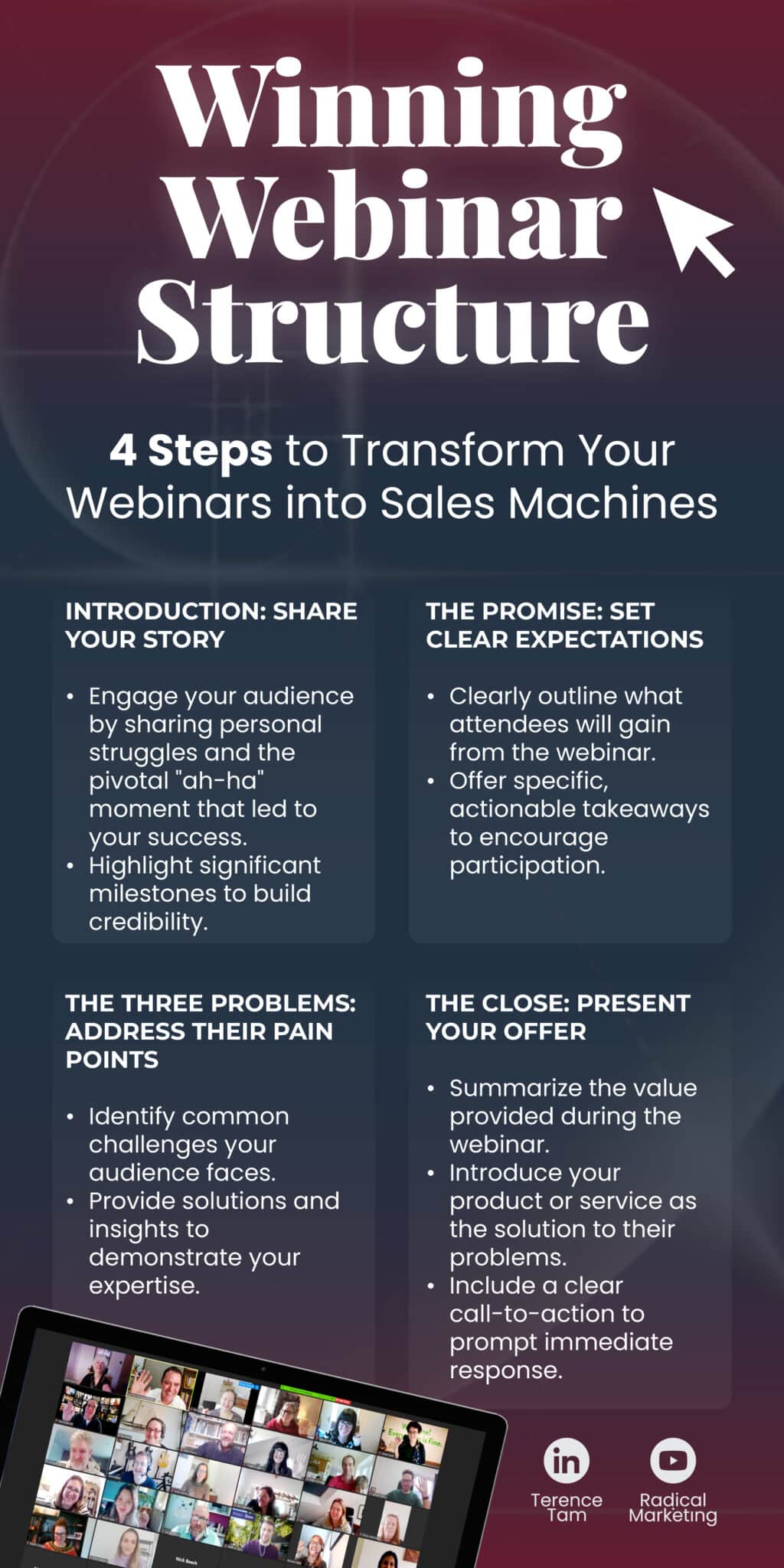
A great webinar is like a movie. It hooks, builds anticipation, and delivers a satisfying ending (aka your offer). And stays engaging throughout.
The Perfect Webinar Structure:
- The Introduction: Your first five minutes make or break your webinar. This is where you need to grab attention, build connection, and establish authority—all without boring them to death. Storytelling can work really well here by making you relatable (and, by proxy, likeable).
- The Promise: Give people a compelling reason to stay until the end. If you don’t do that early on, people will check out (literally and mentally).
- The Teach: Solve SOME of their problems… not ALL. Give them just enough valuable content to feel like they’re learning, but not so much that they think, “Cool, I’ll just do this on my own.”
- The Offer: A great offer isn’t a hard left turn where you suddenly start selling out of nowhere. It’s a logical next step after solving the problems you introduced earlier. It should be smooth as butter and demonstrate value.
- The Squeeze: This is where you give them a reason to act NOW. Whether it’s a limited time offer, or limited slots only for the next session, or live-only bonuses, there needs to be something that gives that extra ‘squeeze’.
Step 7: The Post-Webinar Goldmine
Think your job is done when the webinar ends?
Think again.
Most sales happen after the webinar—if you follow up properly!
Post-Webinar Follow-Up Strategy:
- Send the replay ASAP – But keep it available for a limited time.
- Follow up with urgency – “Spots are filling up fast” works.
- Multiple touchpoints – Email, SMS, and even personal DMs work wonders.
- Book calls, not just sales – For high-ticket offers, a sales call closes the deal.
Frequently Asked Questions About Webinar Marketing in 2025
How much should I spend on webinar ads to get a good ROI?
For high-ticket webinars ($1,000+ offers), a good rule of thumb is to budget between $2,000-$5,000 for your initial ad spend. This gives you enough data to optimize your campaigns. The key metric to watch isn’t just total spend, but cost per registrant and cost per attendee. In 2025, a healthy benchmark is $15-30 per registrant and $30-60 per live attendee for high-ticket offers. Once you’ve found winning ad creatives, scaling becomes much more predictable.
What’s the ideal webinar length for high conversions in 2025?
The optimal webinar length has actually decreased in recent years. While 90-minute webinars were once the standard, attention spans have shifted. For most markets, 60-75 minutes is now the sweet spot – with about 45 minutes of content and 15-30 minutes for your offer. If your webinar runs longer than 75 minutes, you’ll see significant drop-off before your call to action. Remember that a tighter, more focused presentation almost always outperforms a longer one.
How can I increase my webinar show-up rate?
Low show-up rates are the silent killer of webinar campaigns. To maximize attendance: 1) Use a 3-part SMS sequence (day before, hour before, and “we’re starting now”), 2) Create FOMO with live-only bonuses that genuinely add value, 3) Schedule webinars on Tuesday-Thursday evenings (7-8pm local time) which typically see 15-20% higher attendance than other times, 4) Use a pre-webinar questionnaire that creates commitment, and 5) Send registrants a customized calendar invite with reminders. These five tactics together can boost your show-up rate from the industry average of 25% to 40%+ consistently.
Is it better to run live webinars or automated/evergreen webinars?
Both have their place in 2025. Live webinars typically convert 30-40% better but require more of your time. Automated webinars allow you to scale without constantly presenting. The smart approach is to start with live webinars until you’ve perfected your presentation and offer, then create an automated version while still running live sessions periodically. Many successful marketers use automated webinars for initial lead generation, then invite those leads to special live sessions with enhanced offers.
What’s the biggest mistake people make when marketing webinars?
The biggest mistake is treating the webinar as a one-time event rather than a comprehensive marketing system. Too many marketers pour resources into getting registrations but then neglect the critical pre-webinar engagement and post-webinar follow-up sequences. Statistics show that 70% of sales happen AFTER the webinar, yet most marketers spend less than 20% of their effort on post-webinar conversion strategies. A properly executed 7-day follow-up sequence can double or even triple your overall conversion rate.
How do you create urgency in a webinar without sounding pushy?
Authentic urgency comes from real limitations, not artificial ones. Instead of generic “this offer expires tonight” tactics, focus on legitimate reasons for timing: 1) Limited implementation capacity (you can only work with X clients per month), 2) Upcoming price increases due to added features or resources, 3) Group cohort start dates, 4) Genuine bonuses that have real costs associated with them. When you explain WHY the urgency exists rather than just stating a deadline, your conversion rates increase while maintaining integrity.
What conversion rate should I expect from my webinar?
For high-ticket offers ($1,000+), a healthy webinar funnel in 2025 typically converts at: 30-40% of landing page visitors to registrants, 35-45% of registrants to live attendees, and 5-15% of attendees to buyers. This means your end-to-end conversion from landing page visitor to customer should fall between 0.5% and 2.5%. If you’re below these benchmarks, the specific stage where you’re underperforming will tell you exactly what needs optimization – your landing page, your attendance rate, or your presentation/offer.
How do I keep my audience engaged throughout the entire webinar?
Engagement requires both content structure and interactive elements. Structure your content with a pattern interrupt every 7-10 minutes – shift from teaching to story, from slides to your face, or introduce a quick activity. For interaction, use polls strategically (not just for engagement, but to segment your audience for better targeting), encourage chat participation with specific questions, and acknowledge attendees by name. The most engaging webinars follow a “teach, story, application” rhythm that keeps attendees mentally stimulated throughout.
Do I need professional equipment to run a high-converting webinar?
While professional equipment can enhance your presentation, it’s not the determining factor in webinar success. At minimum, you need: 1) A reliable internet connection (wired is better than WiFi), 2) A decent microphone (a $50-100 USB mic is sufficient), and 3) Adequate lighting so people can see your face clearly. Many 7-figure webinar businesses started with basic setups. Focus first on your offer, content, and marketing – once those are working, you can upgrade your equipment to enhance the experience.
What’s the most effective way to follow up with webinar registrants who didn’t attend?
The most effective approach is a multi-channel “replay sequence” that segments non-attendees based on their engagement. Send them: 1) An immediate replay email with a 24-48 hour expiration to create urgency, 2) A “key insights” summary for those who don’t have time to watch the full replay, 3) Testimonials from previous customers who were initially hesitant, and 4) A special “second chance” offer that expires soon. Using both email and SMS in this sequence typically results in a 10-15% conversion rate from no-shows, which can dramatically increase your overall campaign profitability.
What if Marketing Webinars was Easier?
There you have it. Webinars aren’t dead. Bad webinars are.
If you:
✅ Pick the right topic
✅ Nail your funnel
✅ Drive targeted traffic
✅ Maximize show-up rates
✅ Deliver a killer webinar presentation
✅ Follow up like an expert stalker…I mean closer
Chances are, your webinar is gonna kill it.
But what if marketing webinars was easier?
What if you didn’t have to go through all the trouble of:
- Researching your ideal customers
- Studying which topics resonate with them
- Constructing sales funnels from scratch
- Building high-converting landing pages
- Designing your own ads
- Setting up a comprehensive follow-up system to squeeze every bit of profit from your webinar?
In that case, you’ll need a team of marketers crazy enough to do all that work for you – so you can just focus on the things you’re brilliant at, like coaching people and inspiring change.
Good luck!