Perpetual Profit Engine (Part 2 of 5): The Traffic Certainty Principles

Cover Image

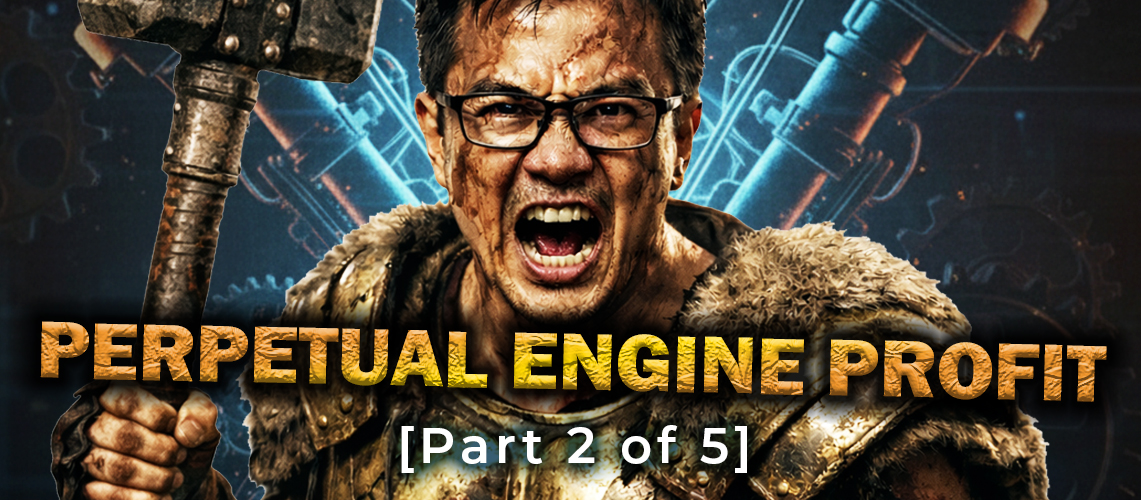
Your Ads Are Gladiators
(And Most Are Getting Slaughtered)

Running ads is basically BRUTAL gladiator combat.

Every time you hit publish, you’re throwing a fighter into the arena. They’re up against bigger competitors with deeper pockets, better weapons, and more experience.

Most ads don’t survive their first week.

They get outbid, ignored, or buried by the algorithm. You watch your ad spend drain while your “champion” gets pummeled by some competitor who figured out the game before you did.

The question is: how do you train gladiators that actually WIN?

That’s what this post is about.

What This Post Covers

This is Part 2 of a 5-part series called the Perpetual Profit Engine.

In Part 1, I covered the 10 non-negotiable protocols for building a client acquisition system that runs predictably.

Today, we’re zooming in on traffic and ads specifically. I’m calling these the “Traffic Certainty Principles” because following them takes your ads from “hope and pray” to “reasonably confident this will work.”

I’ll also share how we used these principles to take a client from barely breaking even to a 12X return on ad spend.

Let’s get into it.

OR Listen Here:

Why Most Businesses Can't Scale Their Ads

Before we talk about what works, let’s talk about what doesn’t.

After running ads for hundreds of clients over the past decade, I’ve noticed three mistakes that kill ad performance over and over again.

Mistake 1: Obsessing Over Cost Per Lead

This one’s counterintuitive, so stick with me.

Most people want cheap leads. Makes sense, right? Lower cost per lead means more leads for the same budget.

But here’s the problem: cheap leads are often broke leads.

If you’re selling a $5,000 coaching program and your ads are attracting people who can barely afford a $27 ebook, you’ve got a conversion problem disguised as a traffic win.

I’ve seen businesses celebrate $3 leads while their sales team complains that nobody on their calls can actually afford the offer.

What you want is the right balance: leads that are affordable AND qualified. People who actually have the problem you solve and the budget to pay for your solution.

Cost per lead matters. But return on ad spend matters more.

Mistake 2: The "Hope and Pray" System

This is the most common approach I see.

Launch a bunch of ads. Run them for a while. Hope something works.

Maybe you test a few images. Swap out some headlines. Tweak the targeting.

But there’s no real system. No methodology. Just vibes and prayers.

The problem with hope and pray is that even when something works, you don’t really know WHY it worked. So you can’t replicate it. And when it stops working (which it will), you’re back to square one.

What you need is a systematic approach to finding what works. A process that consistently identifies winning ads, scales them, and then beats them with something better.

Mistake 3: Lazy Creativity (Or Lack Thereof)

I know some of our clients work with multiple agencies. That’s fine. More firepower, in theory.

But here’s what actually happens a lot of the time.

Agency B looks at what Agency A is running. They copy the ads. Change a few words. Swap the image. Launch it as their own “creative.”

It’s embarrassingly common in this industry.

And it’s not just agencies copying each other. They’re also copying your competitors. Everyone ends up running variations of the same five ads, and then they wonder why performance is tanking.

The ad platforms know this, by the way. Meta and Google are increasingly rewarding genuine creativity. They want users to have a good experience, which means they want fresh, engaging ads. Not the same recycled garbage everyone else is running.

If your ads look like everyone else’s ads, the algorithm will treat them like everyone else’s ads. Which means mediocre results at best.

The Case Study:
From Breaking Even to 12X ROAS

Let me tell you about Eason.

Eason runs a trading education business. When he came to us, he’d already been through multiple agencies. He was frustrated because despite spending decent money on ads, he was only breaking even.

Breaking even means you can’t scale. You’re running in place. Every dollar you put in barely comes back out.

First campaign we ran for him? 12X return on ad spend. For every dollar he invested, he got $12 back.

Same business. Same offer. Same audience. Different approach.

ARE YOU NOT ENTERTAINED?!

(Sorry. I’ve been waiting this ENTIRE article to use that quote.)

Anyway. What follows are the four principles that made that possible.

Principle 1: The Law of Proximity

Before you spend a single dollar on ads, you need to know where your ideal customers are actually hanging out.

This sounds obvious. It isn’t.

Most people just default to Facebook or Google because that’s what everyone does. But “everyone does it” isn’t a strategy.

Your customers might be more active on LinkedIn. Or TikTok. Or Reddit. Or YouTube. Or some combination of all of these.

The only way to know is to do actual market research. Figure out where they spend their time online. Understand how they make buying decisions. What content do they consume? Who do they follow? What platforms do they trust?

Once you’ve done that research, test your assumptions. Don’t just guess. Spend some money and see what the data tells you.

Don't Get Held Hostage

Here’s another reason to diversify your traffic sources: platform risk.

Meta bans ad accounts all the time. Sometimes for legitimate reasons. Sometimes for no apparent reason at all. And getting reinstated can take weeks.

If all your leads come from one platform and that platform decides to ban you, your business stops. Completely.

I’ve seen it happen. It’s not pretty.

You want at least two traffic sources that work. Ideally four or five. Think of it like a table. One leg and you’re unstable. Four legs and you’re solid.

The big two are usually Meta and Google. But don’t ignore TikTok, LinkedIn, YouTube, Pinterest, or even X (formerly Twitter). Test them. Find what works for your specific audience.

Principle 2: The Rapid Testing Principle

Here’s how most people test ads:

  1. Create one ad
  2. Run it for a few weeks
  3. Decide it doesn’t work
  4. Create another ad
  5. Repeat

This is painfully slow.

Here’s how we do it:

Launch 20+ ad variations at once.

Different angles. Different hooks. Different creatives. Throw them all into the arena and see who survives.

When we launched Eason’s campaign, we tested 20 different angles simultaneously.

One angle was about day trading for just 30 minutes a day. Another was about getting funding for your trading account even without much starting capital. A third was about using AI to automate your trading.

Guess which one won?

The AI angle. That was the one that got us the 12X ROAS.

But here’s the thing: if we’d tested these angles one at a time, it would’ve taken months to find the winner. By testing 20 at once, we found it in weeks.

Variations Within Variations

Once you’ve identified your top 5-6 performing ads, you want to create more variations within those winning angles.

Same core message, but different executions:

  • Long-form video vs. short-form video
  • Talking head vs. narration with B-roll vs. animation
  • Photo of speaker on stage vs. testimonial image vs. text-heavy image vs. meme

Meta’s algorithm (especially after their Andromeda update) rewards accounts that give it lots of creative options. The AI can match specific combinations to specific audience segments. More variations means more opportunities for the algorithm to find winning combos.

So test aggressively. Give the algorithm plenty of ammunition.

Principle 3: The Champion Principle

Out of your 20+ gladiators, one will emerge as the champion.

This is your winning ad. The one that delivers the best return on ad spend.

A few important notes on identifying your champion:

Judge by angle, not by creative.

The core theme and messaging matter more than the specific image or video you used. If an angle is working, you can always create new creatives around it. But if the angle itself is weak, no amount of pretty visuals will save it.

Focus on ROAS, not CPL.

I mentioned this earlier, but it bears repeating.

Let’s say Angle A gets you $5 leads and Angle B gets you $10 leads. Angle A looks better, right?

But what if Angle A only returns $1.50 for every dollar spent, while Angle B returns $5?

Angle B is your champion. The higher cost per lead is irrelevant because the quality of those leads is dramatically better.

Feed Your Champion

Once you’ve identified your champion, invest in it.

Create more variations around that winning angle. New images. New videos. New copy that tells the same story differently. Maybe a version that leads with emotion instead of logic. Maybe a version that uses storytelling instead of bullet points.

This keeps the ad fresh while preserving what made it work in the first place.

But Know When They're Tired

Even champions get fatigued.

After running for a few weeks or months, your winning ad will start to decline. The audience gets tired of seeing it. The algorithm shows it to everyone it’s going to work on. Performance drops.

This is normal. Don’t panic. Just be ready with fresh variations to rotate in.

The goal is to squeeze as much value out of your champion as possible while they’re still in their prime.

Principle 4: The Quantum Principle

Feeding your champion only gets you so far.

Eventually, you need a NEW champion.

This is how you create quantum leaps in performance. Going from 2X ROAS to 5X or 6X ROAS doesn’t happen by tweaking your existing ads. It happens by finding a completely different angle that outperforms everything you’ve done before.

For Eason, our original champion was the “AI trading bot” angle. It worked great. But we didn’t stop there.

We developed completely new angles:

  • How to live the wealthy nomad lifestyle through trading
  • How to use AI to remove emotions from your trading decisions
  • Different psychological hooks entirely

Eventually, we found an angle that beat the original control.

With another client, this approach took us from $30 leads down to $4-5 leads. Same offer. Same audience. Just a different angle that resonated more strongly.

Always Be Challenging

The temptation is to find something that works and ride it forever.

Resist that temptation.

The market changes. Competitors copy your approach. Audiences get bored. What worked six months ago might be stale today.

You should always have new angles in development, waiting to challenge your current champion. Think of it as a constant tournament. Your best ad holds the title until something better comes along to take it.

Bonus: Your Landing Page Matters Too

Quick detour, because I can’t talk about ad performance without mentioning this.

You can have the best ads in the world. But if your landing page sucks, none of it matters.

Your landing page is where conversions actually happen. A 10% improvement in landing page conversion effectively drops your ad costs by 10%. It’s leverage.

Here’s what a high-performing landing page needs:

Clear headline that matches your ad

If your ad promises one thing and your landing page talks about something else, you’ll lose people immediately. Congruence matters.

Who this is for

Call out your ideal audience explicitly. Help the right people self-identify and the wrong people self-select out.

Benefits of attending/signing up

What will they learn? What will they get? Make it specific.

Credibility elements

Logos of companies you’ve worked with. Media mentions. Speaking photos. Testimonials. Anything that proves you’re legitimate.

Objection handling

FAQ section that addresses the reasons people might hesitate.

Social proof

Testimonials from people like them who got results.

Clear CTA

Make it obvious what you want them to do next.

One thing people forget: as you create more ad variations, make sure they still align with your landing page. If you’ve got 20 different ads all pointing to the same landing page, some of those angles might not match the page messaging anymore.

Either create landing page variations for different angles, or make sure your page is general enough to support all your ad themes.

Putting It All Together

Let’s recap the Traffic Certainty Principles:

  1. Law of Proximity — Know where your customers hang out. Test multiple platforms. Don’t get held hostage by any single one.
  2. Rapid Testing Principle — Launch 20+ ad variations at once. Find winners fast instead of testing one at a time for months.
  3. Champion Principle — Identify your best performer by ROAS, not CPL. Feed them with fresh variations. Know when they’re getting tired.
  4. Quantum Principle — Always be developing new angles to beat your current champion. This is how quantum leaps happen.

And don’t forget the landing page. It’s the small hinge that swings the big door.

What's Next

In Part 3, we’re going to talk about something most people completely ignore: the psychology of getting people to actually show up for your events.

You can have the best ads, the best landing page, and a flood of registrations. But if nobody shows up to your webinar, none of it matters.

I’ll share the pre-event strategies that took one client’s show-up rate to 25% (which is massive in this space).

Stay tuned.

Ready to Stop Gambling With Your Ads?

If you’re a coach, course creator, or service provider doing $300K+ and you’re tired of unpredictable ad performance…

We should talk.

We’ve helped clients go from breaking even to 12X ROAS. From $30 leads to $4 leads. From “hope and pray” to actual systems that scale.

Book a call to see if we’re a good fit

No pressure. Just a conversation to see if we can help.

This post is Part 2 of the Perpetual Profit Engine series. Read Part 1 here if you missed it.

Share This:

Facebook
Twitter
LinkedIn
Pinterest

Read More Articles:

Perpetual Profit Engine (Part 2 of 5): The Traffic Certainty Principles

Your Ads Are Gladiators(And Most Are Getting Slaughtered) Running ads is basically BRUTAL gladiator combat. Every time you hit publish, you’re throwing a fighter into the arena. They’re up against ...
READ MORE

Perpetual Profit Engine (Part 1 of 5): The 10 Protocols for Predictable Business Growth

The Real Reason MostBusinesses Can’t Scale Here’s what I’ve noticed after serving hundreds of different businesses and generating close to 2 million leads over the past decade. Many of these ...
READ MORE

The 2026 Coach Marketing Blueprint: How to Get Clients Up to 3X Faster With a Multi-Funnel System

Table of Contents A friend recently told me he replaced his psychologist with ChatGPT. I wish I was joking. But that’s the world we’re living in now. People are genuinely ...
READ MORE

Leave a Comment

Your email address will not be published. Required fields are marked *

Scroll to Top